Popular modern choreographies by Jiří Kylián, Hans van Manen, and András Lukács return to the Hungarian National Ballet’s repertoire with live orchestral accompaniment. The program titled Timeless Contemporary is performed four times between 11 and 29 March 2026. As part of the Petőfi Cultural Program, a version of the show titled Timeless Contemporary Adventure aimed primarily at secondary school students will welcome eight thousand viewers within the historic walls of the Opera House between 11 and 20 March.
With The Nutcracker, the Hungarian National Ballet achieved great success last week in Venice, Italy, and now offers further proof of its versatility with its Timeless Contemporary show. Composed of works by world-famous choreographers and composers, the programme tells, through the language of dance the deeply relatable story of the relationship between man and woman. Whether it is playful lovers’ quarrels, constantly shifting relationship dynamics, reckless emotional currents, or layered expressions of sensuality and elegance, the aesthetic fusion of dance and music offers easily accessible and uplifting moments for everyone, interpreted by a world-class company.
In Trois Gnossiennes, premiered in 1982, the recently deceased outstanding Dutch choreographer Hans van Manen transformed the unspoken thoughts of two people into movement set to three magically beautiful piano pieces by Erik Satie. The gestures reveal mutual dependence, trust, and the relativity of hierarchy and subordination. The piece is presented with double casting by Lili Felméry and Mikalai Radziush, as well as Adrienn Pap and Boris Zhurilov, accompanied on piano by György Lázár and Nataliya Pinelis.
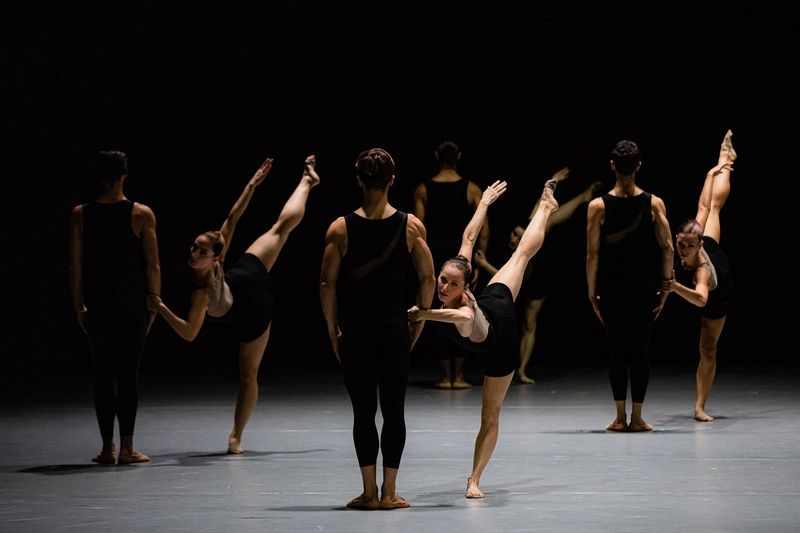
The driving force of Philip Glass’s pulsating, repetitive music comes to life in Whirling, a choreography created in 2010 for the company by András Lukács, a former soloist of the Hungarian National Ballet. This creation for nine couples, rich in spiral movements, also explores the dynamics of male–female relationships and mutual dependence. In the double casting of the performance, the solo roles are danced by Jessica Carulla Leon and Iurii Kekalo, as well as Lea Földi and Louis Scrivener, featuring on the piano are Yevhanii Fomin and Elena Kovacevic.
In the second half of the program, two works by the world-renowned Czech-born choreographer Jiří Kylián, set to music by Mozart, will be performed. Created to mark the 200th anniversary of the composer’s death, Petite Mort is choreographed to the slow movements of Mozart’s Piano Concertos Nos. 21 and 23 and features six women, six men, and six swords as central elements. In the elegant yet bold, sensual yet disciplined choreography, soloists of the ballet company including Tatyjana Melnyik, Motomi Kiyota, and Soobin Lee, as well as Maria Beck, Lili Felméry, Maria Yakovleva, Adrienn Pap, Gergő Ármin Balázsi, Iurii Kekalo, and András Rónai will appear on stage, with piano solos by György Lázár and Nataliya Pinelis.
The refreshingly lively closing piece, Six Dances, translates the playfulness of Mozart’s music into movement. Created in 1986 to the melodies of the Six German Dances, the fast-paced scenes mixed with absurd pantomime provide excellent opportunities for the corps de ballet dancers to shine. Wearing powdered wigs, they bring plenty of humor to help us laugh at ourselves. Enhancing the theatrical experience, the two Kylián choreographies and the work by András Lukács are performed with live accompaniment by the Hungarian State Opera Orchestra, conducted by the young conductor brothers of Hungarian descent, Paul Marsovszky and Johannes Marsovszky.
Alongside the series, a version of the programme aimed primarily at secondary school students will also be shown in March as part of the Petőfi Cultural Program. The selection titled Timeless Contemporary Adventure introduces young audiences to the world of modern ballet with the triple bill of Whirling, Petite Mort, and Six Dances. In these introductory performances, the same casts as in the “adult” productions will appear on stage with two daytime performances each day. Schools may register for the performances through the county representatives of the National Institute of Culture.