
A Streetcar Named Desire
Details
In Brief
Featuring on recording the Hungarian State Opera Orchestra, Modern Art Orchestra, Kornél Fekete-Kovács, László Dés, András Dés, Miklós Lukács, Gábor Winand, Kati Károlyi
Conductor Vajda Gergely, Dinyés Dániel
Sound engineer Kurina Tamás
Sound mixer Dorozsmai Péter
The audio recording was made at Tom-Tom Studio.
Lyrics of the song Lullaby featured in the performance were written by Nemes István
Translated by Bán Zsófia
Performed by Lou Nemes-Palloc
Parental guidance
Events
Premiere: June 17, 2017
Synopsis
Act I
As a nursery tune softly plays, two little girls play on the empty stage.
The vision-like image is broken by a figure emerging from the darkness: It is Blanche, looking uncertain as she arrives in the vibrantly bustling – and steamy – city of New Orleans with a suitcase in her hand. As she reaches her sister's building, the noise from the street subsides.
Stella's flat. Blanche waits alone for a little while – taking the occasional drink to settle her nerves – before the two sisters meet for the first time in many years: they regard each other happily, examining how much the other has changed. Blanche is unable to conceal her disdain for the shabbiness of Stella's home. Stella reassures her sister; the pas de deux danced by the two women embodies their sisterly bond, and also brings the past to life around them: their home, a house named Belle Reve, and all of its horrors. The deceased family members who – nursed through their long suffering by Blanche alone – left no bequest behind – even the house had to be auctioned off. Overcome with feelings of guilt, Stella eventually flees from the terrible scene. Blanche remains alone.
Stella's husband, Stanley, approaches in the cheerful company of two friends. Arriving home, he finds Blanche in his house: two great characters have met...
The days pass with the two avoiding each other in the narrow confines of the flat and the tension between Stanley and his sister-in-law growing ever greater. Blanche's long baths to “soothe her nerves” aggravate him, as does the constant smell of her perfume in his home, and her fine and expensive clothes too. In one taut moment he can stand it no longer and tears through Blanche's suitcase, rummaging through the furs and tiaras to find the papers that will establish at last what happened to the inheritance due from the sale of Belle Reve. It turns out that not a single penny was left from the house. Stanley informs Blanche that Stella is going to have a baby; Blanche greets the news with exaggerated joy, and the two sisters go out to have fun.
Stanley's friends come over to play poker. The game is still going when the women come home. To Stanley's displeasure, one of the men, Mitch, takes note of the attractive Blanche. Blanche turns on the radio, and the women get into a pillow fight in the next room. Deciding he's had enough of the uproar, Stanley storms into the other room and smashes the radio. He starts menacingly toward Blanche, and when Stella blocks his path, he delivers his wife a tremendous slap on the face. As the other men restrain the raging Stanley, the two women flee to the protection of their upstairs neighbour. After Stanley calms down, he calls out despairingly for his wife, who eventually returns home to him. From above, Blanche watches them embrace lovingly.
Memories return to the lonesome woman in a flood: she thinks of her own late husband, Allan. One evening at a ball, she discovered that he was in love with another man. He killed himself later that same night. Blanche gradually returns to reality, and Stella also awakes from the sleep that followed the night of passion. Blanche tries as hard as she can to convince her sister to leave Stanley, but Stella won't hear of it. After secretly observing the two women for a while, Stanley emerges. Stella thinks for a moment and chooses her husband, leaving Blanche alone with her impotent rage.
Act II
It's raining. Blanche nervously gets herself ready to go out. Mitch appears with a bouquet of flowers, kissing her awkwardly before the two leave together for a night spot. They, they start dancing light-heartedly, but Blanche suddenly thinks she sees her dead husband and his lover amidst the swirling crowd as she relives that horrible night at the ball when Allan shot himself in the head. Gradually, however, the dance music dies down, leaving Mitch and Blanche alone on the dance floor. Bidding farewell at last, Blanche departs.
Stanley appears suddenly and angrily tells Mitch what he has just learned about Blanche: back in the town of Laurel, she had prostituted herself to soldiers. It also emerges that when Blanche was a teacher, she had seduced one of her pupils. Astonished by what he's heard and overcome by despair, Mitch attempts to argue with the imperious Stanley, and then rushes off in anguish. Stanley returns home to find Stella getting ready for her sister's birthday party, which throws him into yet another rage. He doesn't think that this loose woman deserves any kind of celebration. Suddenly Blanche arrives. An awkward silence falls as they sit at the table.
The fourth chair – Mitch's – is empty. Since it's Blanche's birthday, Stanley asks her for a dance, which she accepts gladly. Later during the party, however, Stanley grabs Blanche's suitcase and tosses it out of the flat. Stella is upset at her husband's conduct, but Stanley just treats her rudely too. Stella starts to feel ill. Her husband grabs her and races her to the hospital.
Mitch arrives and angrily demands for Blanche to tell the truth about her past. Uncomprehendingly, Blanche attempts to defend herself against the increasingly violent man until finally managing to scare him off.
Blanche takes some medicine and starts drinking. After she puts on her old evening gown, the deceased Allan appears to her and places a tiara on his wife's forehead. One by one, a procession of men dance with Blanche, who is increasingly losing touch with reality. Stanley returns home: the two of them eye each other with just as much hostility as during their first meeting. Stanley's behaviour toward Blanche is increasingly vulgar and menacing. When she tries to flee, he blocks her path. Finally, after turning the flat upside down chasing after her, he wrestles her to the ground and rapes her repeatedly.
Blanche lies motionless on the floor. Finally, she drags herself to her feet and escapes to the bathtub. Madness is already evident in her eyes. Characters from the past and present perform a mighty dance macabre. The dance of death gradually abates, leaving Blanche curled up in the tub.
Media
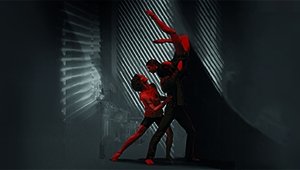
Reviews
“A world première and Venekei's first full-length work for the Hungarian National Ballet, this close adaptation of William’s 1947 work, is a pearl not to be missed.”
Katja Vaghi, Bachtrack
„The sublime pointe adaptation of Blanche DuBois’ drama is drenched with the symbolisms belonging to the original play. (…) New Orleans of the 1940s is one of the great protagonists of the performance, as the jazzy rhythm and modern ballet emphasize the setting of the story.”
Chiara Isabella Spagnoli Gabardi, Gainsayer
“A Streetcar Named Desire (…) made a remarkably lasting impression on the audience. With Venekei Marianna’s thoroughly crafted choreography, the American classic by Tennessee Williams was able to function as a two-act dance drama and appeal strongly to the emotions, while the stylish music by László Dés, well known as a jazz musician, successfully created the appropriate atmosphere.”
Meinhard Rüdenauer, Der neue Merker
Ballet guide
Introduction
Tennessee Williams moved to New Orleans in 1939; his career as a playwright was then jump-started with the success of the play The Glass Menagerie (1944). After that he started to create the character of Blanche DuBois in his mind: “I simply had the vision of a not very young woman sitting in a chair all alone by a window with the moonlight streaming in on her desolate face. She’d been stood up by the man she planned to marry. I think my sister inspired me because she was crazy in love with a young man. (...) He was extraordinarily handsome, and Rose was crazy about him. (...) They were seeing each other, but then the man just stopped calling. Rose’s mental health deteriorated afterwards. The Streetcar was born from this vision.”
The play – just like Williams’ other works – has several biographical aspects. The character of Stanley Kowalski reflects not only Rose’s wooer but also Williams’ alcoholic and aggressive father (For example, during a fight in a poker game, someone bit a chunk out of his ear). Williams himself also had a depressive personality, but mostly it was his beloved sister, who inherited the neurotic nervous system: she was treated for schizophrenia for many years, then with their mother’s, Edwina’s, consent – who was also emotionally unstable – she underwent a lobotomy and was hospitalized for the rest of her life. The figure of Blanche DuBois is a manifestation of the traits of both Williams’ mother and sister: she is the figure of a sophisticated and beautiful Southern girl (Edwina) and the frail and mentally unstable woman (Rose). Tennessee Williams said the following about the heroine of A Streetcar Named Desire: “She was a demonic character; her feelings were too great for her to contain, and so she escaped into madness.” The play was premiered on Broadway in 1947. One year later the work won the Pulitzer Prize, it debuted in London in 1949, and an iconic film starring Vivien Leigh and Marlon Brando was made by Elia Kazan in 1951, which made him instantly famous all over the world. This play, which deals with the problems of the 21st-century man with disconcerting directness, has since been considered one of the most popular American dramas.
The choreographer’s concept
For a long time, I have been concerned with the fact, that I feel audiences cannot really grow fond of modern ballet and contemporary dance. The vast majority of the 20th-century dance works deal with a rarefied and abstract subject, usually without any actual plot in one act, or not even a full act, only some pas de deux, or in mere 20 minutes, which usually cannot enchant or catch the audience’s attention because it is difficult to get a grip on these works. But if modern works were composed of stories, enabling the audience to connect to the given form, a visual sensitivity and receptiveness to understanding and feeling how a dancer expresses emotions, thoughts and feelings in a more modern visual language would emerge more easily. If the audience does not develop this aesthetic system, modern pieces simply remain a purple haze.
I made it my mission to do something in order to make contemporary ballet clearer to the audience. One night in 2008, I went to see A Streetcar Named Desire directed by Géza Tordy in the Tivoli Theatre. Of course, I knew this piece before, and I also saw Elia Kazan’s film from 1951, but this was the time when I realised what a fantastic basis this play could form for a contemporary ballet, and I immediately started to seriously think about the topic. I think that after the “pink candyfloss” of picture-perfect and romantic ballets, such as Swan Lake, Giselle, The Sleeping Beauty, and La Sylphide, it could be extremely exciting for the audience to hear a tougher libretto and a more realistic story: it is the drama of a woman to whom we might relate more easily. Blanche loses everything, the world around her gradually falls apart, and something breaks in her. Indeed, a whole world – our circumstances, our existence, our love or friendship – can be lost in an instant, unfortunately. Anyone can become Blanche.
First, we needed a libretto, which accurately describes the structure of the play. Dés and I had several meetings, we talked everything through again and again, what should or should not be left out of the original drama, what is important or less important. He addressed it as a composer, I approached it as a dancer. This is how we fine-tuned the libretto. Dés said what kind of leitmotivs and instruments he was thinking of, what kind of atmospheres and rhythms he imagined in each part, and we talked over how long each scene should be. When he composed a part, he played it on the synthesiser, sent me the recording, and I started to make the choreography. We have changed only one thing in the libretto over the course of the past almost 10 years: when it turned out that we could perform Streetcar after all, and had a fresh look at the libretto again, we both thought that at the very end of the play, after Blanche goes insane, we should not return to the reality of New Orleans, and show how Blanche is taken to a mental hospital. This is because tension is gradually growing, and the drama is heightened further after the middle of Act II, reaching a point where it is impossible to boost the scenes further. We thought that in our work there would not be any catharsis if the play ended with the last scene of the original work; therefore, our ending differs from that of Williams. We enable Blanche to take an escape route, and we leave it to the audience to decide what will happen to her.
Marianna Venekei
The composer’s thoughts
It is not every day a composer gets the chance to compose music for a ballet, especially for such an exciting and complex psychological drama as A Streetcar Named Desire. I immediately put aside every other planned project and began working with Marianna. We constructed the plot of the ballet on the basis of the Williams’s play, and I started to write the music in the spring of 2010. It has been a long march since 2010, but maybe everything is just fine as it is: Marianna also said that during this time the piece matured, and the kind of world and dance-language that should be created for the work was further crystallised.
Composing music for a ballet is unique as what otherwise is told in words in the play, has to be told in these two abstract genres, using the language of dance and music. This is a particularly difficult job. We had to be very careful to draw the fine line somewhere, to decide how much can be shown, and how, since if a play gets too didactic, it becomes comical rather than remarkable. Contrary to many other musical genres, music here is the story itself, and this is thrilling. Every single bar and sound of A Streetcar Named Desire, a 100-minute stream of music, tells a story. It was particularly important during composition to think in motifs. For example, all four protagonists are accompanied by a given instrument throughout the piece: these instruments display the different shades of personality, emotions and anger of the characters. Finding a balance between genres and the instrumentation itself were all very exciting processes.
The play takes place in New Orleans – this, of course, had to be taken into account, but I did not want to be stuck in dixieland by any means. I largely concentrated on psychological happenings instead of the milieu and the age. Thus, four genres are present in the music: chamber jazz, jazz big band, contemporary chamber music and mostly contemporary symphonic music. We already decided back then that music would not be played live but from a recording because the orchestral apparatus would require a jazz combo, two hand percussionists, at least two symphonic percussionists, a grand symphonic orchestra with more than forty strings, double woods, brasses, a cymbalum, a big band, a male tenor, a little girl’s voice, etc.
Marianna Venekei had one or two particular requests relating to the music, but she left 90% of the material up to me. For example, she imagined the first meeting of Blanche and Stanley as if two huge beasts stood face to face in the jungle, and she wanted percussion music for that. There were scenes and parts in the play, where we could come up with obvious musical solutions, motifs, and rhythms, while in other cases we had to think about them a lot. When, for example, the monotony of living together is illustrated – the way Stanley and Blanche stalk around and annoy each other in the small apartment – I knew right away that it requires repetitive music. Yet other parts were not that evident: for example, when the four guys play poker, it was a challenge to render this into music, but I think I solved it.
We followed Tennessee Williams’ linear dramaturgy, because what is so exciting about the play is that Blanche’s past is recaptured piece by piece: an unknown woman arrives in New Orleans and stands there with only one suitcase. What is her secret? Why is she neurasthenic and sensitive? This only becomes clear slowly, in light of past events. So, the play takes place in two timelines: in the present, in which things happen mostly in the limited space of the small apartment, and in the past when space and time expand, and big scenes are brought to life with many dancers – including the ball at which Blanche’s husband killed himself. We play with these shifts: alternating between narrow and broad, chamber and big scenes, present and past. I hope that musical motifs will also help the audience to understand these timelines. I trust that even those who are not familiar with the story will understand it with the help of modern dance and modern music.
László Dés
István Nemes: Lullaby
Once there lived a prince
who feared the silvery moon,
and his heart always beat
with terror at its brilliant face.
Once there lived a prince
who feared the dark of the night,
and when the moon shone down,
the waters were full of gold.
Once there lived a prince
who feared the dark of the night,
and to flee the moon,
he hid in his castle of gold.
All is at rest now.
Prince, your castle
and the moon are all at rest.
English translation by Arthur Roger Crane