
Best of Händel / Dido & Aeneas
Details
In Brief
Henry Purcell’s epic masterpiece, Dido and Aeneas has to do with the Trojan War. But what is even more important than the historical background of this hour-long little gem is love – as Dóra Barta, the director of the production highlights it, “Humanity has long known that if there is something you can die of, Love is certainly such a thing. Whether it is happy or not, returned or unrequited, one thing is sure: it is dead serious business. The tragic-ending romantic affair enfolding between the queen of Carthage and the Trojan hero was made into a grand classic of universal cultural history by Virgil, but it was the thirty-year-old Henry Purcell whose music made its heroes rise to the stars, among which they have been shining with never fading light for three and a half centuries now.”
The compositions of Georg Friedrich Händel, who spent most of his life in England and whose works, aside from Messiah, are rarely performed at the Opera House, create an authentic Baroque atmosphere ahead the tragic love story of the Trojan prince and the of Carthage, the most significant work by an outstanding figure of English early music, Henry Purcell.
Parental guidance
Events
Premiere: Oct. 13, 2022
Synopsis
Act I
Under the rule of Dido, the queen of Carthage, who is in possession of great creative power, the city grows and prospers. Nevertheless, she has been consumed by melancholy for some time, and she is unsure if she can find peace ever again. What could be wrong? After all, the empire has never been so fortunate. Belinda, the queen's lady-in-waiting, suspects the reason: Dido has fallen in love with Aeneas, the Trojan warrior enjoying their hospitality after fleeing to Carthage following the fall of Troy. Perhaps even Dido fears of admitting the truth to herself, being afraid of loss and pain, being afraid of weakening as a leader if she succumbs to her emotions. However, the ladies of the court encourage her: it would be beneficial politically if Troy and Carthage were united. Moreover, Aeneas also seems to be in love with Dido. When the hero appears, Dido first gives him the cold shoulder, but later she cannot control her emotions and surrenders herself to love, while a never-ending doubt starts a certain internal destruction in her soul.
Act II
Scene 1
Happiness is never easy: dark shadows appear, the Sorceress can no longer bear to look upon the success of the empire and Dido's happiness. Therefore, she decides to put an end to both. He calls her witches for help and shares her plan with them: the evil spirit appearing in the image of Mercury, the messenger of the gods will let Aeneas know that he must set out immediately. This will cause Dido to despair and die of her pain, and Carthage will be consumed by flames. The witches improve the excellent plan with another idea: they will conjure up a storm around the lovers while they are hunting, thus separating them in order to carry out the evil deed.
Scene 2
Dido and Aeneas happily indulge in the pleasures of hunting, but Dido hears the thunder, which puts an end to their fun. They return to the palace, but Aeneas is halted by Mercury, i.e. the evil spirit of the Sorceress, who tells him that he must set out tonight to establish the new Troy in Italy. Aeneas has no other choice than to obey the divine command, but he has no idea yet how to tell his lover...
Act III
Scene 1
The sailors bid farewell to their casual lovers and prepare for the long voyage. The Sorceress and her witches are satisfied, their plan is going well. The Sorceress comes up with another idea: she will make Aeneas die in the sea during a storm to complete the guile.
Scene 2
In her palace, Dido feels that her initial fear was well-founded. The thing she was afraid of, the reason she did not want to succumb to love has come to pass. Even Belinda cannot comfort her. Aeneas comes to say goodbye, but Dido has already given up on this relationship. Seeing her desperation, Aeneas would stay refusing the divine (or what he believed to be divine) command, but Dido is adamant. She no longer wants to continue this relationship. After Aeneas leaves, the once strong queen weakens, collapses, there is nothing left for her but death, since nothing will harm her in her grave, she will not have to face similar torments to what this love brought her. The rest say goodbye to her hoping that the god of love himself will watch over her grave.
Media
Reviews
"The production, which took place at the Miklós Bánffy Stage in Eiffel Art Studios, was an opportunity to show the Hungarian State Opera working on a more intimate scale than usual, intended to be a point of introduction to opera for a younger generation – a nod, as director Dóra Barta stated in her programme note, to the work’s historical origins as an opera composed for a girls’ school. There was nothing ad hoc or ‘studenty’ about this Dido, however. This was a staging of Purcell’s opera with high production values, stylish music-making and superb singing."
Ashutosh Khandekar, Opera Now
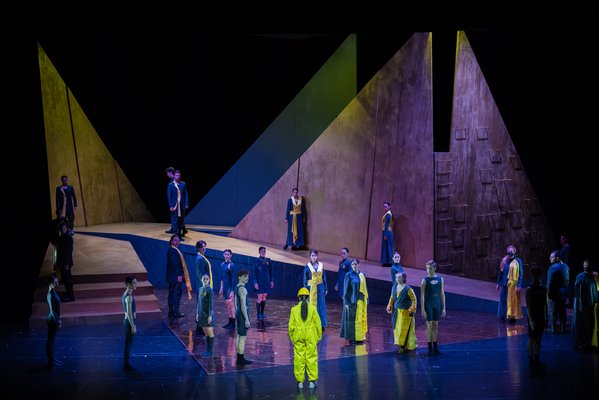
“Director-choreographer Dóra Barta adapts the opera with a keen sense, adding quite a few new threads to the original plot. Right at the beginning of the piece, uniformed schoolgirls rush from the auditorium onto the stage, as if the director were invoking the performers of the premiere. Cheeky and flirtatious, they are archetypes of adolescence, regardless of the century they live in. (…) The ‘time travellers,’ appearing from time to time, follow Dido’s fate, prompting emotional identification among younger audience members as well.”
Gábor Lénárt, Art7
“The minimalist set featuring geometric forms functions well, making scene changes seamless. The stage images that depict non-specific spaces, along with the stylized costumes operating in shades of grey and yellowish gold, lend the story a sense of timelessness. (…) The clean and modern choreography can at times feel slightly abstract, but it clearly and effectively illustrates the events.”
Zoltán Péter, Operaportál
Opera guide
Nothing has changed
Henry Purcell composed Dido and Aeneas for a girls’ school. I incorporate this historical fact as a motive in my production, because I believe there is an exciting analogy to be discovered between the circumstances of the work composed 333 years ago and the purpose of this year’s (2022) staging: the latter is also intended as an inaugural theatrical production for young audiences. Just as the piece sent a message to young girls about the world in its time, I would like to send a message to the youth of present day as well. Moreover, during the creative process, I would like to examine whether the fundamentals of the world – such as the attitude towards love – have changed – over the course of more than three centuries. As far as emotions are concerned, nothing seems to have changed.
Dido is an iron-willed, constructive, and successful ruler. Aeneas is a true idol. Their relationship could have resulted in something great. However, with the appearance of love, Dido loses her strength, gives way to fear, and all the evil forces we see, the Sorceress, the Spirit, and even the storm itself can easily be interpreted as her inner, upset state of mind. It says a lot about the queen that no matter how broken she is at the end, in her last dialogue with Aeneas she is seen again as a strong personality. What is it that I want to convey to the youth with the performance? It is important to be alert, because if any negative thought preys on your mind, it can only have a destructive effect on your own life.
Dóra Barta (director–choreographer)
As if turning the pages of an encyclopaedia
Purcell’s opera first premiered in 1689 at a girls’ school in London. The presentation served a dual purpose. On the one hand, due to the conciseness of the one-hour opera, it was an “introductory” work to acquaint the viewers with all the possibilities of the opera genre, the use of chorus and ballet beside the singers expressing a wide range of emotions in music, with, supernatural elements and magic as well as a series of stage illusions as if turning the pages of a small encyclopaedia about all the elements and possibilities in an opera performance, how versatile it is, how many emotions and characters from this world and beyond this truly genre of “all arts” can enumerate.
On the other hand, the purpose of the presentation as a tale of initiation might have also been to reveal to the students at the girls’ school what difficulties they will have to face in adult life, what serious choices they will be forced to make. After all, a new power will want to take control over their destiny: the unbridled emotion that means no threat to them as a child, but later on they must learn to control it wisely, if they do not want to end up like Dido, who cannot control her emotions well from the start, making her forebodings almost inevitably become her destiny. All this is embedded in a story inspired by Trojan mythology, told through a wonderful musical composition: Dido and Aeneas is one of the masterpieces in opera history, which we present to our young audience in its original form, featuring a small orchestra (as it could have taken place at the girls’ school), and performed in English (after all, today’s young people know the musicality of the English language well from popular music).
Director/choreographer Dóra Barta’s diverse performance unfolds the potentials of the all-embracing art form: the continuous presence of young dancers, the unusual use and the dynamic spatial forms of the chorus on stage, the special scenery and the costumes all serve the purpose of making this one hour a true “introduction” into the genre of opera, and the piece spanning several ages arriving among the audiences of the 21st century, created from an industrial hall. In order for the performance to be able to speak to them, the 17th-century adaptation of the ancient story is complemented by some cotemporary, atmospheric musical inserts by Bence Farkas, thus making the story even more “familiar”.
András Almási-Tóth (dramaturg of the production)
The remarkably expressive music of Dido and Aeneas
At the time of the premiere of the opera Dido and Aeneas, people were undoubtedly familiar with Virgil’s Aeneid, which the piece is based on featuring on the most exciting episodes, namely, the protagonist’s meeting with Dido. This was adapted by Purcell in such a way that, in addition to being serious, he also illustrated and complemented the story with the introduction of witches, an echo chorus and tempest music. These also provide a certain humorous/satirical/sarcastic undertone.
The music of Dido is not easy to perform. In many places, for example, the sung material is recitative, which requires impeccable diction, and for the music to be truly expressive, this requires effort even for native English speakers. Purcell composed remarkably expressive music and not only through the representation of the aforementioned forces of evil and natural phenomena. Dido’s famous lament at the end of act three could almost be the pinnacle of romantic composition. The method the composer constructs the aria, the way he starts from low and increases over long bars (not using the terraced dynamics typical of Baroque, and even avoiding outbursts), he is practically two hundred years ahead of his time. In this production, a string quintet and a harpsichord accompany the singers. The exact number of instruments used at the world premiere is unknown, it might have easily been only scarcely more. Thus, ours can be interpreted as a kind of contemporary instrumentation, which is made modern by special atmospheric music – combined with the usage of contemporary dance.
László Bartal (musical director of the performance)