
Kapcsolatban maradunk (Keep in touch)
Walking Mad, Bedroom Folk, Black Cake
Details
In Brief
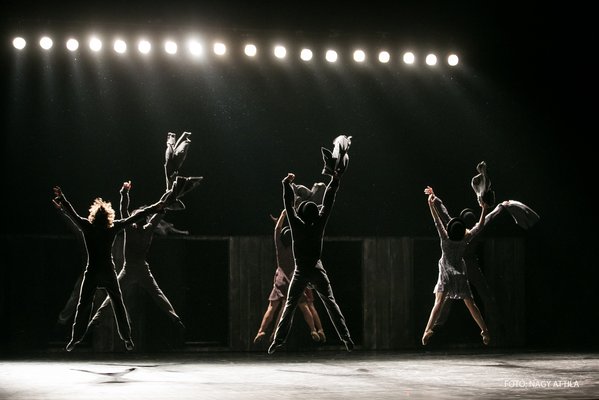
The Hungarian National Ballet invites fans of contemporary dance on an incredible journey, in which the company reveals a completely different face of the genre. An exciting blend of classical and modern music, suggestive lighting, acrobatic movements, and a unique wall create a distinctive atmosphere on the Bánffy Stage of the Eiffel Art Studios. Let us find ourselves in madness, create order out of chaos, and never let go of each other’s hands at a whirlwind party, because everything falls into place as long as we keep in touch.
Events
Premiere: May 17, 2001
Walking Mad
Johan Inger, former artistic director of the Cullberg Ballet and a former dancer with the Royal Swedish Ballet and Nederlands Dans Theater (NDT), made his debut as a choreographer nearly a quarter of a century ago at the encouragement of the highly influential Jiří Kylián. His first attempt (Mellantid) was immediately crowned with success, followed by numerous further choreographies, including Walking Mad, created in 2001 for nine dancers to Ravel’s Bolero. The work is based on the Socratic observation: "our biggest blessings come to us by way of madness". "The famous Bolero from Ravel with its sexual, almost kitschy history was the trigger point to make my own version. I quickly decided that it was going to be about relationships in different forms and circumstances. I came up with the idea of a wall that could transform the space during this minimalistic music and create small pockets of space and situations. Walking Mad is a journey in which we encounter our fears, our longings and the lightness of being," said the choreographer.
Bedroom Folk
Sharon Eyal and Gai Behar are among the most exciting, original creative pairs in contemporary dance. The Jerusalem-born Eyal was a dancer, and later a choreographer, with Israel’s exceedingly important Batsheva Dance Company before forming her own ensemble, the L-E-V Company, in 2013, with which she appeared in Budapest in April 2017. Her creative and romantic partner, Gai Behar, is a DJ and underground creative specialist in Tel Aviv. In 2015, they composed Bedroom Folk for the Nederlands Dans Theater (NDT 1). Music, dance and light each receive equal emphasis in the choreography, which is little more than half an hour in length. The creation, which blends clean, uniquely designed and exotic dance elements and operates with suggestive colours and lighting, has a captivating atmosphere which is both serious and silly at the same time. It is controlled chaos which points the way to the future.
Black Cake
The NDT was turning 30 years old when Jiří Kylián informed Hans van Manen, “You’re going to do the ballet for the anniversary.” Manen replied: “Really? And what should I do?” Kylián replied: “A cake”. This is how the festive parody of five movements built around humour – the irresistibly witty Black Cake – was conceived. Van Manen imagined a cocktail party on the stage with six couples, a waiter and a great deal of champagne. In the bravura finale the guests, already slightly tipsy, dance to the music of the famous Meditation from Massenet’s Thaïs. The celebratory premiere in 1989 was a dismal failure. After the performance, a posh reception was held on the stage, and, as van Manen’s recalled, everybody pretended as if he did not exist. Then, 18 months later, Kylián said to van Manen, “We’re going to do Black Cake again.” Again, all the choreographer could think to reply was, “Really?” It has been performed with huge success all around the world ever since.
Media
Ballet guide
Walking Mad
This dance performance with a captivating mood, minimalist spectacle and powerful contemporary movement vocabulary was originally made for the dancers of the Nederlands Dans Theater (NDT) in 2001 and has won many major awards. Maurice Ravel’s well-known Bolero inspired the choreographer, but he regarded this very familiar, frequently adapted piece as only a starting point. “Walking Mad is a journey in which we encounter our fears, our longings and the lightness of being”, Inger explains. However, the journey, to which the opening image of a man arriving in a hat and coat unmistakably refers, also explores the absurdities of daily life, naturally in the context of the timeless subject of the relationships between men and women. As the thoughts of the piece do not follow a single strand throughout, the choreographer likewise finds unexpected ways to use the music.
It may seem crazy that the well-respected piece of music is abruptly interrupted, falls silent, and then a short while later starts again. As such, it is precisely the sweep of the music that the choreographer cuts. Then, finally, the last chord of the dance work is not Ravel’s usual climax, but a work in stark contrast, Arvo Pärt’s poetic piano piece Für Alina (1976), which sets the background of the parting duet about separation and letting go. The main creative prop on stage is a moveable plank wall rolling on wheels, which expands the movement options: it can be climbed on, hung from, slammed into; doors open and shut in it, but it can also fall, only to lift the dancers’ bodies up when it rises again. It can be danced on and against... It is the symbol of the limits, opportunities, barriers and gateways of our lives...
Rita Major
Bedroom Folk
Bedroom Folk, born from the flourishing collaboration between Sharon Eyal and Gai Behar, was premiered by the Nederlands Dans Theatre (NDT1) in 2015. Since then, the work based on constant experimentation and the fusion of dance languages in a way that synthesizes harmonically throughout, has enjoyed international success. As with most contemporary works, there is no story to Bedroom Folk; all one has to do is let the sight exert its effect! In the opening scene, an array of four women and four men slowly march forward in a dense formation that will later be disrupted so that each of the dancers can assume their individual tasks. And this is as it should be, for each of the NDT’s dancers in a unique and genuine individual, only comparable to each other in their shared high level of their dance skills. As the music rhythmically speeds up, the movements depart further and further from minimalism.
Through the tightly yet energetically choreographed steps, the characters reveal themselves, as the dancers do the momentary relationships tautening between them. All of this is rounded out by the lighting, as the space depicted by the warm colours bursting out of the darkness contribute at least as much to the atmosphere of Bedroom Folk as the music or the dancing itself. Like so many contemporary choreographies, this can be interpreted as a study on the relationship between the individual and the group, while at the same time, the work’s structure itself, reminiscent of a rondo, is controlled momentary freedom breaking out of order. Bedroom Folk was first presented in Hungary by the Hungarian National Ballet in October 2018.
Black Cake
Hans van Manen’s ballet was premiered by the Dutch Dance Theatre in 1989. The cast for the premiere of this musical montage of works by five composers included dancers who are regarded as giants of choreography today, for example Paul Lightfoot and Nacho Duato, both of whom are well known to Hungarian audiences. According to an anecdote, as the NDT was turning 30 years old, Jiří Kylián, the world-famous Czech choreographer turned to van Manen, who led the company as an artistic director for 25 years: “You’re going to do the ballet for the anniversary.” Manen replied: “Really? And what should I do?” Kylián replied: “A cake.” This mockingly witty intermezzo inspired van Manen to create this unusual and fresh piece, which is at once intimate and universal, elevated and amiably secretive.
Black Cake is an absurd association of terms and a mockingly pleasant gift from the Maestro, who was present at the conception of the NDT and had a decisive impact on the company, educating generations of dancers and making his artists interpreters of his excellent works. In this piece, Manen shows his – rarely used, but all the more powerful – humour, playfully dragging up the curtain that hides the behind-the-scenes area of the dramatic shrine hidden from the eyes of the audience. He juxtaposes the solemn and the profane, the ethereal and the fallible: his virtuoso dancers stagger amusingly towards us with a glass of champagne in their hands, sometimes stepping out of their roles. Because they are humans too.
Tamás Halász