
La Bayadère
Details
In Brief
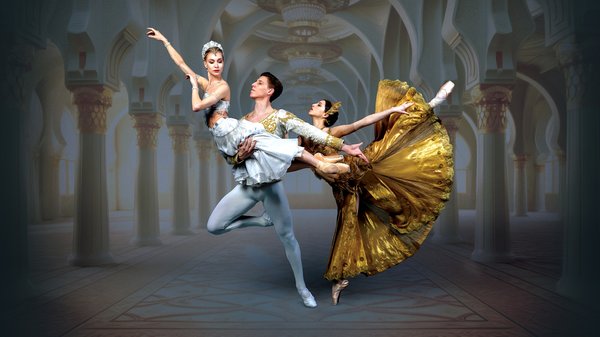
Marius Petipa’s choreography takes the audience to legendary India to witness the tragic love story between a temple dancer and a noble warrior. La Bayadère is an excellent example of the classical ballet tradition, but the new Hungarian National Balett production will prove to be a real treat. The records of the original 1877 choreography are incomplete, the fourth act of the ballet is lost. Thanks to the efforts of ballet master / choreographer Albert Mirzoyan, with the reconstruction of the missing parts, the complete story can be enjoyed again.
Parental guidance
Production warnings
Strong flashing lights are used in some scenes of the performance which could disturb those with photosensitivity.
Events
Premiere: June 14, 2025
Synopsis
Act I
Scene 1
A group of young warriors led by Solor are hunting tigers. Before venturing deep into the forest, Solor orders the fakir Magdaveya to take his message to the bayadere Nikiya that he would be waiting for her outside the temple. The priests led by the High Brahmin march out from the temple to participate in the Festival of Fire. The fakirs and the temple dancers or bayaderes are performing a holy dance – the beautiful Nikiya is among them. After the ceremony the High Brahmin, forgetting his dignity and his oath as a priest, confesses his love to Nikiya. He promises her all the treasures of India, but she rejects him. The bayaderes offer the fakirs water from the holy well. Magdaveya secretly passes Solor’s message to Nikiya, which fills her heart with happiness. Night descends, and Nikiya obeys the call of love. Although the fakir guards their secret rendezvous, the High Brahmin can overhear the lovers’ conversation. Solor suggests Nikiya eloping together. The girl agrees but asks Solor to swear by the holy fire that he would be faithful to her forever. The High Brahmin prepares for his revenge and turns to the gods for punishment.
Scene 2
The Rajah Dugmanta tells his daughter, Gamzatti that she would soon meet her fiance. Solor arrives at the palace; the Rajah introduces his beautiful daughter to him, and announces their engagement. Solor is impressed by Gamzatti’s beauty and cannot refuse to marry her in spite of her oath to Nikiya. Nikiya is summoned to the palace to Gamzatti’s betrothal celebration. The High Brahmin appears too, and wants to inform the Rajah about Solor’s secret vow. Dugmata sends away everybody, feeling that the priest’s visit is related to the oncoming wedding. Gamzatti overhears the conversation between the Brahmin and his father, and thus learns that Solor is in love with Nikiya. Although Dugmanta loses his temper, he does not change his intention that his daughter should marry Solor. The Rajah decides that the bayadere cannot be an obstacle to the marriage, so she has to die. The Brahmin expected to dispose of his rival with his intrigue, but now he is shocked to hear the Rajah’s cruel decision. Nikiya returns, and so Gamzatti can meet her rival, who is really beautiful. The Rajah’s daughter boasts of her approaching wedding and invites the bayadere to dance at the event, and deliberately shows her Solor’s picture. Nikiya is exasperated, since Solor swore eternal faithfulness to her at the temple. Gamzatti demands Nikiya to give up Solor, but the bayadere is rather ready to die. The Rajah’s daughter offers jewellery and richness to her, but she rejects the proposal indignantly, as she would not leave her love for any treasure. During the heated debate Nikiya attacks Gamzatti with a dagger, but the servant Aiya steps in between them, and the bayadere runs away desperately. Gamzatti realizes that she can only get Solor if Nikiya dies.
Act II
A spectacular celebration is going on in the garden of the Rajah’s palace on the occasion of Solor’s and Gamzatti’s wedding. Nikiya has also been invited to delight the guests with her holy dance. The bayadere must not reveal her sorrow, but she cannot help glancing at her beloved Solor again and again. Aiya hands over a basket of flowers to Nikiya in the name of the Rajah, but she has hidden a snake in the basket on Gamzatti’s order. The bayadere continues her dance even more joyfully, believing that it was Solor who has sent her the present. As she is holding the basket, the snake bites her. The Brahmin offers her an antidote to the poison in exchange of her love, but the bayadere remains faithful to her love, and chooses death instead. Solor desperately collapses on the dead body of his beloved.
Act III
Scene 1
The inconsolable Solor is suffering from remorse. He orders Magdaveya to bring some opium to dispel his torturing thoughts.
Scene 2
After Solor falls in a deep dream, shades emerge from the darkness. They descend from the peaks of the mountains in a long line, and Nikiya is among them too.
Scene 3
The warrior awakens from his dream. The rajah arrives accompanied by Toloragva. He warns Solor that the time has come, the wedding is approaching. The young man receives his words reluctantly, yet he is ready to fulfil the promise he made to Dugmanta.
Scene 4
At the wedding ceremony, the guests greet the young couple with dance. One of them hands a basket full of flowers to Gamzatti, who immediately throws it away. It reminds her of the basket that once hid the venomous snake that caused the death of the bayadère. Solor envisions Nikiya, but the rajah pulls him back to reality. The union is soon to be sealed. The great Brahmin blesses the couple, and everyone enters the temple. But happiness cannot follow Gamzatti and Solor on their path. The wrath of the god Vishnu strikes down, destroying the temple. In death, Solor and the bayadère are reunited, their love is stronger than anything else, now in eternity.
Media
Reviews
“Hungarian National Ballet’s La Bayadère is the very definition of sumptuous, virtuosic, ‘big’ classical ballet. This new version by company ballet master Albert Mirzoyan is based on Marius Petipa’s 1877 original, but with the added bonus of a reconstructed Act 4, often omitted by tradition. The result is an opulent throwback to the heyday of grand, Imperialist Russian ballet, still vital in this exciting revival.”
Gianmarco Segato, Bachtrack
“Albert Mirzoyan's staging of La Bayadère after Petipa, no question, is a very elaborate, complex, and costly production. (…) All this contributes meticulously to the perfect storytelling, which in the purest dance language, is transmitted to the audience. Even to those who happen not to know the ballet.”
Ricardo Leitner, Attitude Devant
“Particularly noteworthy is the formidable corps de ballet in all of its appearances but especially in the Kingdom of the Shades scene, where 32 dancers descend four sloped ramps in flawless arabesque penchée to continue their dance on stage in absolute synchrony. Lines, formations, everything is perfect and a visual delight.”
Ira Werbowsky, Der neue Merker
Ballet guide
The choreographer’s thoughts
Marius Petipa created the choreography for La Bayadère in 1877 for the St. Petersburg Bolshoi Theatre (today’s Mariinsky Theatre). It was a four-act classical ballet with the lavish grandeur befitting the Tsarist era. At the time, both the St Petersburg theatre and the Moscow Bolshoi Theatre shared the same director. In 1904, following a suggestion by ballet master Alexander Gorsky, La Bayadère, which had already been performed successfully in St Petersburg for years, was also introduced in Moscow. However, the sets were not produced a second time; instead, the existing ones were transported between the two cities. The risks of this transportation were clearly illustrated by an incident in 1907 that significantly influenced the fate of the ballet: the set for the fourth act failed to arrive at the venue in time for a performance.
Gorsky had to act quickly, the audience could not be let down. There was no choice but to conclude the piece with the third act. The curtain fell in the Kingdom of the Shades; Solor, the protagonist, never awoke from his opium-induced delirium. This improvised ending continued to be used in later performances, and by 1920, the original fourth act, with its happy ending, had disappeared completely. In the final decades of the 20th century, distinguished choreographers such as Natalia Makarova and Patrice Bart revived the missing scenes. We are now preparing a version that does not end in the Kingdom of the Shades. I am working on staging the “lost” scenes and developing the concept based on the original libretto, and I am creating the choreography myself.
The Kingdom of the Shades is a highly spectacular and beautiful scene, but from a dramaturgical and logical standpoint, it does not conclude the story. Solor consumes opium and, in a narcotic dream sequence, reunites with his deceased lover, Nikiya. However, he never awakens from the dream. If the story ends here, the narrative threads remain unresolved. In the 2025 version, we return to reality in the brief, roughly fifteen-minute closing scenes. Solor is preparing to marry Gamzatti. However, the god Vishnu avenges the poisoning of Nikiya, the bayadere, and the lovers’ souls are united in eternity. In our production, the third act is followed immediately by the final part, without an intermission.
In 1883, a now-forgotten ballet titled Nuit et jour (Night and Day), by Marius Petipa and Ludwig Minkus, was composed for the coronation of Tsar Alexander III. Only the piano transcription of the work has survived. I handed it to György Lázár, and together we selected the parts that best complemented the existing music of La Bayadère. For instance, we included a section in the second act’s pas d’action block, for which I created a male duet, and a lyrical excerpt placed just before the ballet’s final dramatic scene, offering a strong musical contrast. György Lázár also prepared the orchestral arrangement. He studied the entire work and, staying true to the composer’s style and using the existing score as a foundation, re-composed the missing segments. He did a magnificent job!
The production features exciting characters, the artists perform in beautiful costumes, and the visual spectacle is lavish. The principal dancers showcase their finest technical and acting skills. Interestingly, in Petipa’s time, male dancers had no solo parts, Solor’s variation, for example, was later added to the ballet by Chabukiani. This is a classical ballet, requiring the highest level of technique during the pas d’action, but character roles, modes of expression, and acting are also crucial. One of the ballet’s most distinctive features is undoubtedly the Kingdom of the Shades. This is the scene where 32 ballerinas dance simultaneously, it’s mesmerising how synchronised their movements are. A large ensemble is essential to stage La Bayadère, such as that of the Hungarian National Ballet.
Albert Mirzoyan
The exotic sources of La Bayadère
Since the Age of Discovery, Europe has demonstrated a lively interest in the fabulous wealth, the exotic stories and the fascinating world of the Orient. The intensity of this interest has changed with the centuries, but it has never ceased to exist. At the time of Romanticism, the influence of Indian culture on European art grew again. Naturally, authors sought to build upon details that stirred their imagination rather than straining for authenticity. In Goethe’s ballad The God and the Bayadere (Der Gott und die Bajadere), the dancer fails to recognize the god Shiva who appears in human form and falls in love with him. When morning comes, the god is no longer seen, only the human corpse he has left behind. Obsessed with grief, the bayadere throws herself on the pyre and when she dies, she meets the god again. Schubert intended to put Goethe’s ballad to music, but in 1830 it was Auber whose opera was first performed under the same title in Paris.
It was suggested earlier that the bayadere reflects the figure of Kalidasa’s Shakuntala, but the renowned researcher Roland John Wiley has proved that there is no direct connection. The original story tells that during a hunt, King Dushyanta falls in love with Shakuntala and gives her a ring with a proposal of marriage. The girl sets off to find the king, but loses the ring while bathing in a river. The king thus does not recognize his love, and Shakuntala returns to the forest to give birth to their child. Meanwhile, a fisherman catches the fish that has swallowed up the ring. Seeing the token ring, the King remembers his earlier promises and returns to the forest to find Shakuntala. This short account proves that the only connection between the two stories is the oath of love sworn during the hunt.
French orientalist Antoine-Leonard Chezy (1773–1832) published a translation of the Sanskrit poem under the title La reconnaissance de Sacountala. This, together with the European tour of an authentic Indian troupe of dancers – whose principal dancer, Amani, committed suicide in her grief – inspired Theophile Gautier to write the libretto. Building on Ernest Reyer’s music, Lucien Petipa transposed the poem into dance: Sacountala was performed at the Paris Opera in 1858. Before and after the birth of La Bayadère, several ballets and operas had exotic – oriental, as well as ancient – locales. Amongst the most outstanding ballets, La Peri (Burgmuller–Coralli, 1844) is set in India, The Pharaoh’s Daughter (Pugni–Petipa, 1862) in Egypt, and King Candaules (Pugni–Petipa, 1868) in ancient Greece. Much later, Fokin contributed to the staging of Cleopatra (1909, music by Arensky) and Sheherezade (1910, music by Rimsky-Korsakov). Though far from being exhaustive, we should also mention operas like Delibes’s Lakmé (1883) set in India, or Verdi’s Aida (1871). La Bayadère (Baiaderka in Russian) was first performed in the Bolshoi Theatre in St. Petersburg on 4 February (O. S. 23 January, according to the Russian calendar) 1877. The word ‘bayadere’ comes from Portuguese and has the same meaning as the Sanskrit ‘devadasi’: Hindu temple dancer. Using his own ideas and Sergei Khudekov’s libretto, Marius Petipa prepared a ballet in four acts and seven scenes.
Márk Gara
The fate of the ballet in the 20th century
Since it would be fruitless to list all the reductions and changes La Bayadère has had to go through in the last century, only the most significant ones are mentioned. Although La Bayadère was never entirely dropped from the repertoires of the Imperial Theatres, Petipa himself decided to revive the ballet in 1900. After Petipa (but still during his lifetime), it was Gorsky who made the first modifications in Moscow in 1904. Later changes aimed at rendering the decor more authentic, or various parts were removed. The great flood of St. Petersburg is often blamed for the disappearance of the entire fourth act in 1920, though some people think that it was the emerging Soviet regime that banned the last act which displays divine punishment. Therefore, Cyril W. Beaumont could give an account of only 5 out of the 7 original scenes in his 1937 book.
Vladimir Ponomarev modified the ballet in 1941, which featured Natalia Dudinskaya and Vakhtang Chabukiani as the lovers. The pas de deux of Act I, which depicts their flaming love, was created especially for the two dancers. It was Chabukiani who mounted the Solor variation still seen on stage today. In 1948, the ballet was enriched when the variation of the Golden (or Bronze) Idol was inserted. Nikolai Zubkovsky’s choreography is now one of the best-known parts of the ballet, which is usually included in the divertissement of Act II (Nureyev) or in the last scene (Makarova). The music used by Zubkovsky was Minkus’s Persian March, originally composed for the ballet Le Papillon.
La Bayadère did not cross the borders of Russia or the Soviet Union until the 1960s. In the Khrushchevian era of detente, however, the Western world could see part of the ballet when the Kirov Ballet performed The Kingdom of the Shades as a one-act ballet in London and New York in 1961. During the 1961 Kirov tour, while the company was still in Paris, Rudolf Nureyev (1938–1993) asked for political asylum. In 1963, he staged The Kingdom of the Shades in London using his own recollections. He danced the leading part as the partner of the legendary English ballerina Margot Fonteyn (1919–1991).
Later another world-famous dancer, Natalia Makarova also defected from the Soviet Union and staged The Kingdom of the Shades (1974, with Cyntia Harve and Ivan Nagy) and later, in 1980 the full-length ballet for the American Ballet Theatre in the USA. This version, known as Makarova’s production, is the most popular one in the world. It is performed on the stages of London, Stockholm and Milan. Its great advantage lies in the fact that it follows the entire plot from the first sparks of love until the divine ordeal, i.e. the destruction of the temple. Makarova wished to lay emphasis on the dramatic character of the ballet and the dance while omitting much of the mime. The balanced dramaturgy of La Bayadère is able to captivate the attention of the audience and – in case of the presence of excellent soloists – provide a lifelong experience.
The next milestone was the premiere in Paris. The mortally ill Nureyev chose La Bayadère as his swan song. His production is largely based on the 1900 version, though he omitted Act IV. Enthusiastic about telling a story with gestures, Nureyev preserved much of the mime, but it was properly counterbalanced by the extraordinarily refined technique and the graceful performance of the Ballet of the Paris Opera. Nureyev included several passages of the male corps de ballet and recreated the dances of the grand divertissement mostly neglected in Makarova’s production. The Parrot Dance, the Danse Manu and the Danse Infernale were mounted again. Since the last scene in Nureyev’s production is that of The Kingdom of the Shades, the Golden Idol’s variation is included in the grand divertissement.
In 2002, Sergei Vikharev reconstructed this version for the Kirov Ballet using the only available authentic document, the Stepanov notation. Critics deemed the performance interesting from a historical perspective but pointed out that the great number of detailed mimes resulted in a marathon playing time of 3 hours and 50 minutes, which is too demanding for the 21st-century audience. The variation of the Bronze (Golden) Idol disappeared from the ballet, but Vikharev inserted a part after the Kingdom of the Shades scene where Solor is woken up, and the entire Act IV was renewed. Vikharev admitted in an interview that his greatest pride was the Dance of the Lotus Blossoms of Act IV.
The ballet company of the Hungarian State Opera introduced the “white scene of La Bayadère under the title Dance of the Shades on 23 October 1976. It was not a unique enterprise those days: in the 1960’s and 70’s it was mainly this part of La Bayadère which was performed around the world. The piece was rehearsed by N. V. Baltacheyeva and A. L. Kumisnikov with Eva Ehn’s assistance just some months before the 100th anniversary of the premiere of the original ballet. The costumes were designed by Tivadar Mark, the set designer was Attila Csikós, and the conductors were Janos Sandor and Gedeon Frater. Dance of the Shades was only performed on nine occasions – on the last one the world-famous ballerina of Hungarian origin, Maina Gielgud danced Nikiya’s role. Unfortunately, the Dance of the Shades was not later integrated into the Hungarian repertoire.
Until the 2008 production of the Hungarian National Ballet, La Bayadère had been performed just once – although an abridged version, it was still the most complete performance until the 2008 premiere. The occasion was the final examination concert of the Hungarian Dance Academy in 1998. Rehearsed by Flora Kajdani and staged by Imre Dózsa and Katalin Sebestény, this performance consisted of two scenes: Gamzatti’s and Solor’s wedding and The Kingdom of the Shades. Since 2025, the production features the lost parts reconstructed by Albert Mirzoyan.
Márk Gara