
László Hunyadi
Details
In Brief
The production of this work was created based on the critical edition series Ferenc Erkel Operas from the Department of Hungarian Music History of the Institute for Musicology of the Research Centre for the Humanities.
Parental guidance
Events
Premiere: March 13, 2022
Synopsis
Media
Reviews
"In his production general director, Szilveszter Ókovács returned to the so-called original version, which had not been performed for ninety years, containing all arias, dance sequences, ensembles, and even the overture, which Erkel himself added to the 1844 version, in order to give the complicated story more credibility. In addition, the director obsreved the period in terms of staging and performing tradition. Consequently, along with conductor Balázs Kocsár, visual designer Krisztina Lisztopád, choreographer Tamás Solymosi and chorus director Gábor Csiki, he staged a production on the stage of the Opera House that would make Franco Zeffirelli proud."
Wolfgang Sandner, Frankfurter Allgemeine Zeitung
“The production was based on the original version of László Hunyadi, which in the case of Erkel’s operas means that, as opposed to the 20th-century reworking, it relies on a version considered authentic by the composer. Beyond its historical value, this undertaking was also one of the production’s great merits, because the Erkel version functions far better dramaturgically: the scenes follow one another more logically, or transitions shed light on how we move from one point to the next.”
Kata Kondor, Fidelio
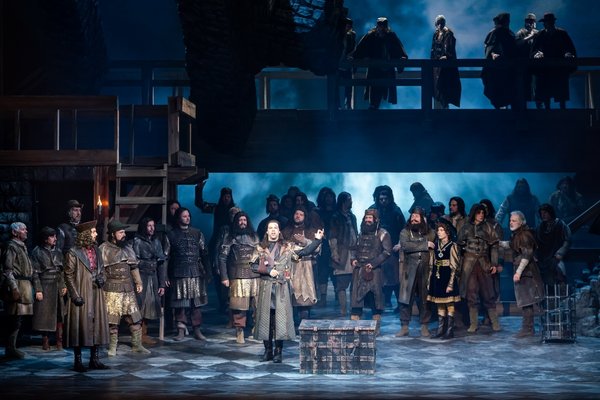
“The completely renovated stage technology brings technical possibilities to the fore: in the first and second acts, the monumental set of the castle (partly collapsed in the background) was built on different levels, making use of the stage’s movable platforms; in the second act, the revolving stage is used very aptly, providing a fine transition between mass scenes and more intimate moments. The whole is realistic and as faithful as possible to the period of the story, and the same can be said of the costumes.”
Claire-Marie Caussin, Opéra
Opera guide
Introduction
“Good heavens! If we were ever again to allow Louis the Great or even John Hunyadi to warble away in Hungarian opera, the theatre would deserve to collapse on the spot.” Thus fulminated Imre Vahot, who could hardly be called an opera enthusiast, following the premiere of the very first Erkel stage work, Mária Bátori. It can scarcely be claimed that this outburst, bordering on an Old Testament curse, had any serious impact on the composer (or on Béní Egressy). For in the very next Erkel opera, even if the victor of Nándorfehérvár himself did not sing, his two sons most certainly did, and Matthias was moreover cast as a trouser role. In László Hunyadi, however, it is not he who matters, but the title character: one of the most idealized embodiments of the Hungarian self-image. And what, then, is László Hunyadi like? Noble and pure of character, he loves his mother and his beloved to the point of adoration, and even his single flaw is a beautiful virtue: good faith. Living among secret enemies, good faith can lead only to fatal consequences, and in this, too, László Hunyadi perfectly matches our collective self-image. He himself is the innocent victim, executed in a manner almost worthy of a horror tale, with the fourth stroke of the executioner committing one final, literally capital atrocity against him. That is, against us. For the aforementioned good faith can already be generalized within the opera itself. For what other reason would the valiant knights who cut down Ulrich of Cilli sing at the top of their lungs in the famous chorus that closes the first act: “A new day dawns, oh Hungarian?” It is as though we were hearing the slogan of collective self-deception that hopes for a miracle, or at least a clean slate,from changes of regime and political course.
Yet it was the 1935 Radnai–Nádasdy–Oláh adaptation that sharpened this to such an extreme. “Only the valiant László, only László sleeps / and he does not listen, / he believes only his enemy…” – laments of this sort were not originally voiced by the anxious supporters of the Hunyadi family, who, after the slaying of the scheming, bloodsucking foe, did not hope for a “new day” but proclaimed the accomplished fact of the “salvation of the homeland.” Not that the work in this form would not still speak about us Hungarians, but it is nevertheless clearer that Erkel and his librettist were thinking first and foremost in terms of an effective Romantic opera, not a grand national parable. Of course, patriotic intent still strongly motivated them, for they wished to create an opera that drew its subject from Hungarian history—and could stand comparison with Donizetti’s and other contemporaries’ historical-looking stage works, rich in stormy clashes and showy vocal writing. And the miracle of László Hunyadi, whose content continued to grow richer for many years after its premiere, is precisely this: the creation of a Hungarian Romantic operatic tone and the iconic stage scenes associated with it. With László’s aria dreaming of his beloved; with the entire part of Erzsébet Szilágyi, trembling for her children; with Mária Gara’s cabaletta, buoyed aloft by the euphoria of bridal happiness; with the joy and mourning of the Hunyadis. Or indeed with the prison and scaffold scenes of the final act, which on the one hand are undoubtedly adaptations of international theatrical templates, and on the other hand just as much our own most intimate possessions, as much so as a poem by Petőfi or a painting by Madarász.
Ferenc László
Back to the roots
Béla futása (Béla’s Flight), an opera by József Ruzitska, opened in Kolozsvár (today Cluj- Napoca) in 1822. Erkel visited the town, and it was a turning point for him when he saw the production and met the intellectual community there. Although German was his first language, Erkel was profoundly influenced by Hungarian culture. After leaving Kolozsvár he spent time at several towns before coming to Budapest. There he first worked as the choirmaster of the Várszínház theatre, then he was invited to the newly founded Hungarian language theatre, Pesti Magyar Színház. He demonstrated professionalism beyond his years when, in his contract, he insisted on the right to decide who could sing, who could become members of the chorus and the orchestra. He greatly improved the quality of music, and success came quickly. The goal was to become a real competitor to the German language theatre, Pesti Német Színház, and they did. Erkel brought the popular pieces of his time to the stage, and audiences got familiar with the operas of Auber, Bellini, Cherubini, Donizetti and Rossini with Erkel as the conductor.
He was greatly influenced by Italian bel canto with its melodic formation and the series of self-contained pieces (arias, duets etc.) with their distinctive structure. Besides bel canto, he was the most affected by French grand opéra, with its historical themes, monumental tableaus and dance scenes. Finally, his time in Kolozsvár, when he saw how Hungary became a part of the operatic scene, was also a formative experience for him and explains the ‘Hungarian elements’ – gypsy music, the verbunkos and palotás dances – in his pieces. Bátori Mária, an opera with almost exclusively bel canto characteristics, was a turning point in 1840, as this was when the state took over Pesti Magyar Színház – which was previously funded by the county – and it became a national theatre. Hunyadi, however, transcended this opera. Erkel’s aim was to merge the musical styles he knew into one and create a Hungarian language opera, but he didn’t wish to innovate as such. His life’s work is absolutely unique. He stands alone among opera composers, having written all his operas about historical events of his homeland.
The plot of Hunyadi László is a historical theme that called for a grand opera in 3 acts. Interestingly, however, the lead character is not so much the titular character but Erzsébet Szilágyi, László and Mátyás Hunyadi’s mother. The reason for this lies in operatic conventions. A key characteristic of the lead character is that he/she sings the aria type aria di sortita, which follows this structural pattern: recitativo – cantabile – tempo di mezzo (middle part) – a fast cabaletta. Usually this is not at the beginning of the opera but is most often performed in the opening scene of the second act. Also, at the end of the opera there is either an aria of the lead character or a rondo-finale, where the lead character has a prominent role. In Hunyadi, this is all Erzsébet Szilágyi. Another key feature of the operas of the time is that the audience learns about the plot in the opening scene, mostly from the chorus, which transitions into an aria by a supporting character, which also explains the story. Originally, in this opera this was an aria by Mátyás. In their 1935 adaptation, Miklós Radnai, the director of the Opera House, Kálmán Nádasdy, the director and Gusztáv Oláh, the set designer cut this aria from the opera.
By reviving the traditional production from before the 1935 adaptation, we wish to show that Erkel’s original version, which was a huge success at the premiere, is, in the 21st century, still a living, powerful musical drama with real, flesh and blood characters. It’s surprising for me that Radnai and the others did not believe in Erkel’s art. Verdi’s Nabucco and Wagner’s The Flying Dutchman were written in the same period, yet they haven’t lost their power, and while their style is rooted in bel canto, there is no need to modernise them. Radnai’s problem was that at the turn of the 19th and 20th centuries, Bánk Bán and Hunyadi László were the only Hungarian operas. Another problem was to find a singer for Bánk’s tenor role, so a baritone version was written, the play was modernised, which was sort of absurd...
Of course, creating new orchestrations and versions is quite common. In the case of baroque operas, every production is different. It is also exciting how you can reconstruct the original intent of the author, even when you use modern solutions or perhaps elements of jazz, like we do here at the OPERA with Monteverdi’s Poppea and Purcell’s The Fairy Queen. But at the OPERA, the audience is informed that this is an adaptation and there is no pretention that it is the original. Anyway, what we have come to know as Erkel’s Hunyadi and Bánk Bán over the course of almost 80 years, are, while close to it, not the original versions. Parts that were left out have been brought back and regained their significance and place. Parts that were subsequently and unnecessarily overwritten were cut back. Interestingly, the most popular parts of Hunyadi, the Overture, László’s aria, the La Grange aria, the Palotás and Mária’s cabaletta were not part of the premiere on 27 January 1844, they were introduced later to the opera. Naturally, these parts will be included in the production. I believe that by reconstructing the Original Hunyadi, we now have a more uniform and more colourful piece.
Balázs Kocsár
Creativity is my life – Notes from the general director / stage director
Young Erkel took the musical scene of the capital by storm right at the end of the Reform era, and his first opera, Hunyadi László – Bátori Mária is more like a successful ‘zeroth’ piece –, was already a masterpiece as it depicted one of the most exciting periods in Hungarian history. An Erkel opera was an obvious choice: the reopening of the Opera House, originally built in 1884 as an example of revival architecture, called for a historic Hungarian piece, and Ferenc Erkel was still the director of music at the time. The opening performance should be something the audience will love, and the key to this is a period-set adaptation – which, I believe, is a bigger and more special challenge than modernising an opera. We have waited for the Ybl Palace to open for such a long time and now we really wish to show the audience what we can do with the amazing stage technology. One reason the Eiffel Art Studios of the OPERA were built (the construction took 9 years) was the production workshops, and now in this grand production they can demonstrate their skills with the sets, costumes and props. At the Palotás, our ballet dancers dance together with the members of our ballet institute, and at one point the members of the children’s ensemble appear. The aim was to have everyone a place in the production, not just the orchestra, the chorus and the soloists.
Creativity is my life, I could never lead the OPERA without taking part in the creative process. I decided to work with Krisztina Lisztopád, who has designed costumes for the Opera a number of times, but so far no sets. Nothing is impossible for her, she is determined, focused and present; we worked together for well over a year on huge plans. We are surrounded by a cast and creative team that help us make our multiple debut: it is not only Kriszta designing sets, me directing, and the original version being heard for the first time, it is also a building that has been closed and restored for years as well as its brand-new stage machinery making their debut.
Some remarks on the adaptation and the libretto
Béni Egressy’s libretto is not the same quality as the works of the great poets, Kölcsey, Arany or Petőfi, but of course this is applied text, written for the music. Another Egressy libretto, Bánk Bán, was revised after World War II, and Hunyadi in the interwar period. Kálmán Nádasdy’s libretto is magnificent and suits the melody perfectly, and Radnai and the other co-authors were ingenious, but they cut large parts and revised the opera significantly. For example, in Act 2 of the well-known Radnai–Nádasdy–Oláh-version, Mária Gara does not appear at the entry of the king, as if spotted by László V (or, rather, pushed to the front by her father), but the act starts with her little cavatina. “A sad dove flew to my window, joining me in my sorrow...” – and even though this is a beautiful and lyrical moment, this music was not written to open the act directly, not for Mária Gara’s voice, not in this key, not for this act, not for these lines, not with these images and not with this message... This is the slow part of Mátyás’ aria, which is the first aria in Act 1, preceded by an overture and a male chorus. The stretta, originally at the end of this aria, was rewritten as a duet by Mátyás and Mária in Act 2.
As for the libretto, I wanted to keep as much of the original as possible, but there were some issues to consider. What should we do with words that have long been forgotten (tombérozni – revel with pleasure)? With old words with their meaning changed (zsivány – rouge)? With words that are easily misunderstood (tündérkecsű – sweet and slender)? With words that have no atmosphere and are not in harmony with the pathos, intimacy or solemnity of the music (pelikán – pelican)? With the unrhymed recitatives (“S e nyomorú féreg, e sehonnai oláh / Halálos ellenem fia meré kérni leányom kezét?” – “And this miserable worm, this vagrant Walachian, the son of my arch enemy – how dare he ask for my daughter?”). With the uneasy prosody (“fölötte villog szörnyűen” – “with the headman’s axe above him”)? The use of images unacceptable today (“bűzhítse vészteljes lehelete" – “his foreboding breath to reek”; “felséges illatú balzsam-leheleted” – “Sweet smelling ointment, your breath”)? With the use of words that hinder singing (a number of high vowels at the highest notes)? Eventually, I altered about one sixth or one seventh of the libretto. Where the images remained the same, I left the well-known Nádasdy-text unchanged, but I ruthlessly cut large parts of it (or, when it would have been a bad decision, I wrote something with a similar meaning) if the use of images or the meaning would have changed a lot. With this revision I wished to pay tribute to the great men before me, Erkel, Egressy, and also Nádasdy and his co-authors – and astonishingly, our great singers also had their say in the matter: they made several suggestions, most of which, if suited the concept, I accepted gladly.
It could even be true – The private myth of the coronation sword
I have been captivated by the sight of the coronation sword ever since my childhood. Nobody talks about it, while the Holy Crown, the mantle, the sceptre, and even the orb are given great attention. As if nobody cared about the blade shortened by being sharpened so many times, damaged by usage and whetstones, the blade that told me a story that it did not know itself. It is the only sword, an exact replica of the regalia, featured in our authentic Hunyadi show, so that it can attract the audience’s attention. Swords were still common in the world of the 15th century. And this single prop we use is a broadsword too, a special kind of sword. It is a straight, symmetrical, long and heavy weapon, the fuller of which was often drenched in the blood of the executed. It is a myth that the executioner “worked” with an axe and with the head of the victim laid on a block: in these parts the convicted were typically made to kneel, or later to sit in a chair in this period, and the beheading was carried out with a two-handed broadsword from the back.
So, the broadsword is not an everyday object, but it is in battle: when needed, it is swung with two hands or "a hand and a half" there too. János Hunyadi certainly had a broadsword as well, and the Hungarian coronation sword is also a broadsword. There are different, but not overly contradictory estimations by historians about our coronation broadsword being made in the 15th century, or possibly the early 16th century, and in Northern Italy. Which is where János Hunyadi stayed for a relatively long time, for two whole years from 1431: he waited in Milan for his lord (or maybe father?), Sigismund of Luxembourg, the freshly crowned holy Roman emperor, originally "only" the king of Hungary. If Hunyadi could get or buy a broadsword in Milan, famous of its blacksmiths and steel, why would he not do it? And why could he not chop Turks with that later? Why could this weapon of his not be left behind in his trunk, and then why would it not be used happily by his elder son, a hero of the southern defence line, or even his other son sometimes, who was over ten years younger, and who later, as a king, gave perspective to the memory of János Hunyadi and meaning to the short life of László Hunyadi even after their death. If attacked, why would László not protect himself against regent Ulrik Cillei, taking his life? And why would palatine Gara not want to have the legendary broadsword for himself, who was one of the most significant provincial lords and king makers? And if the broadsword lies on the top of the corpse in Viktor Madarász's astonishing painting, why could it not have been already there at the execution of the young Hunyadi? And if it was there, what could be a better realization of palatine Gara's (László Garai's) thirst for revenge than not only preparing the death of Hunyadi's son, but seeing the indecision of the executioner, even carrying it out himself, and with the broadsword taken from Hunyadi? And after such a shameful event of a son being decapitated by his father's weapon, why would Mátyás Hunyadi, who reburied his family as soon as he became king, not take this broadsword to start the last big Hungarian royal cycle by finally washing the blood off of it?
That would be quite a grotesque story, and from what I have learned about the Hungarian Middle Ages through working with this piece, the more twists and turns a story has, the more absurd and cruel it is, the more realistic it is. The history of the Hungarian kingdom is a story of taking and abusing opportunities (which one isn't?), and a two-handed broadsword can strike this way and that way too. As the last coronation that was completely valid according to the old requirements was that of Mátyás, if the sword was included then in the other, older regalia, we could think of it as more than a "mere Italian sword", as a relic of the last Hungarian royal dynasty, possibly with the most potential of all dynasties, a relic that lives on with us and can be visited any time under the dome of the Hungarian Parliament. A witness of great battles, sufferings and hopes. A myth? It is, admittedly made up by me, and perhaps telling us more through its symbolism than mere data could do. History? Every inch of it, but put together, only imagination. It could have happened like this, I say in March 2022, until a Hungarian Schliemann comes along to find out: it was not only like this, but even more so…
Szilveszter Ókovács
The great cooperation driving the production – The set and costume designer’s thoughts
When Szilveszter Ókovács asked me to work on the scenic design of Hunyadi László, I was delighted to take on this challenge and to be working with him. The biggest task was, probably, to present the new, modern stage technology through the set of the opening performance at the reopening of the Opera House. This was the reverse of the usual situation: typically you have a stage design and need the technical solutions, now we based the stage design on the technological capabilities. It was a huge challenge to plan the best and most effective way and rhythm to use the new stage technology and demonstrate its potential. The possibilities were also an inspiration: we have moving streets with an interior lift, we have moving platforms that can remove scenic elements quietly yet very quickly. The fly shaft has been modernised and can hold almost 9-metre walls from above, without any other fastening. There is also a quick revolving stage that can move downward, forward and backward as well. Everything is quicker and simpler now, and we make the most of the machinery.
Historical accuracy was very important. At first, I studied icons and miniatures, I based the design on those. A key motif of the opera is grief, this is present in the plot from Nándorfehérvár to Temesvár and Buda, and this must be reflected in scenic design. We could say everything is built on the execution of László Hunyadi: even the wedding scene is a preparation for that; the desolated ruins of the castle, destroyed by the Ottomans and so many others, are a dominant part of the scenery, and are also foreboding. The crooked wall on the stage is also important, it is an iconic part of the set and it also refers to grief, loss and imminent danger. And from that a new kingdom is born eventually.
We have authentic period costumes, even though we ordered costumes that were more typical in the 1500s, while the opera takes place in 1456. The reason for this was to have even more elaborate costumes from the Renaissance and the late Middle Ages. The latter represents the past and the former represents revival, and the characters don costumes from the earlier and the later period depending on their mentality and mindset. The Hunyadi family, for example, are the ambassadors of a new way of thinking and of revival, so they wear realistic Renaissance clothes. The other team, however, Ulrik Cillei, count palatine Gara, the king and the soldiers wear exaggerated, unrealistic, fancy clothing. The process of costume making required meticulous work, and the costume department of the Opera did great and managed it marvellously. This is exceptional in Hungary. Those who work there have significant experience gained in Hungary and abroad. The whole Hunyadi László production is great cooperation. Whatever the director and I come up with, they make it happen, without compromises.
Krisztina Lisztopád