
Leander and Linseed
Details
In Brief
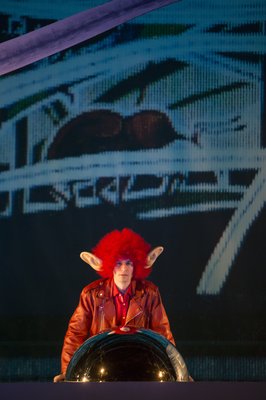
The tale of Leander the goblin and Princess Linseed, brimming with magic and a seemingly unbreakable curse, not to mention a wealth of twists and turns, is a genuinely good yarn. Set to a libretto by Barnabás Szöllősi that is based on Andor Szilágyi's fable for the theatre and written at the OPERA's request in the 2014/15 season, Erkel Prize-winning composer Zsófia Tallér's masterful, expressive and entertaining music makes this Hungarian fairy tale opera an enjoyable experience for children and adults alike, and, we hope, a possible future classic.
Parental guidance
Events
Premiere: April 11, 2015
Synopsis
Media
Reviews
“Zsófia Tallér’s opera opens hearts, and even if love is a banal, childish, deeply outdated, romantic feeling, if it wins, we will be happy. We hear a great composer who composes with certainty even on this scale, whom dimensions liberate, who can unleash upon us the terrifying mass of a wasp chorus, and who at the same time shapes Leander’s melancholic, Schubertian bass-baritone role arc in a bel canto manner, at times even into Wagnerian heroism, while softening Negéd’s Mozartian entrée into Offenbachian operetta after two hours.”
Magdolna Jákfalvi, Revizor Online
“The highlight of the performance, despite all the inventiveness of the direction and the visuals, is Zsófia Tallér’s wonderful music, which conjures before us, and even around us, the fairy-tale world into which we can carefree lose and immerse ourselves. And yet the musical texture of the opera is extraordinarily complex. (…) The orchestra virtuously follows the genres freely juxtaposed by Tallér, the melodic arcs interweaving from opera into operetta and then into ballet. (…) The crowd of children absorbed every single moment of the performance like a dry sponge, but it offers at least as much joy to adult spectators as well.”
Péter Jenei, Fidelio
“Zsótér splendidly understands the language of children; at times the silence becomes almost palpable, which in youth performances could itself be a measure of quality. He staged the plot in a varied and witty way, precisely attuned to the musical punchlines.”
– zéta –, Momus
Opera guide
Introduction
At the beginning there was Benedek Elek’s fairy tale Csudafa (“The Wondrous Tree”), which inspired Andor Szilágyi to write a highly stylized play in archaizing language. This prose Leander and Linseed appeared on stage in 1993, immediately in two places, Szolnok and Cluj-Napoca, and subsequently, and ever since, a whole series of further productions has followed. But the story of the genesis can, of course, also begin from another starting point, namely the Hungarian State Opera’s 2013 commission to compose a children’s opera, which found Zsófia Tallér, who passed away painfully early. She, in turn, discovered Szilágyi’s play and, as she told the author of these lines, it was “love at first reading.” Behind the originality of the story and its unmistakably postmodern self-irony lies the atmosphere of folk tales, but also the mood of Csongor and Tünde, and even The Magic Flute, all of which suited Tallér’s compositional direction extremely well, as she regularly worked with numerous music-historical reminiscences. “There is always a bel canto flavour to my music,” the composer herself declared a few years earlier, and some of this flavour also found its way into the children’s opera, which proved eventful both in terms of its plot and its musical dynamism at the 2015 world premiere at the Erkel Theatre. That production began with an awkwardly, even painfully slow curtain rise, only to culminate in an exhilaratingly energetic finale: with Sándor Zsótér’s successful direction, exemplary intensity of singer-actor performance, and the parade of goblins, tomcats, king, and queen.
Ferenc László
The composer’s thoughts
In November 2013, I was contacted by the Hungarian State Opera to compose a children’s opera. They also offered a ready-made libretto for the work, but at my request they subsequently gave me a free hand, because I wanted to have a personal connection to the chosen subject, since that makes it far more likely that I will also have something personal to say. As the mother of two boys, one might say I am up to date in children’s literature, even if my older son, being twenty years old, no longer has any need for bedtime stories. During my search, two considerations guided me: on the one hand, I was looking for a story rich in action; on the other hand, given the limited time at my disposal, I wanted something that already existed in a stage-adapted form. This led me to the Budapest Puppet Theatre as well, where director János Meczner, almost as a bonus, drew my attention to Andor Szilágyi’s fairy tale Leander and Linseed. I am not exaggerating the impact the story had on me: it was love at first reading.
I was captivated by the strange, stylized language of Leander and Linseed, and by the charming self-irony that permeates the entire work, an irony that can be understood and enjoyed by parents or even older children as well. I liked the very original story, behind which the world of folk tales is nevertheless present, along with the atmosphere of Csongor and Tünde or The Magic Flute. And this fairy tale also corresponded perfectly with my preliminary intention that something should always be happening on stage. This sense of movement in the story is excellently preserved in Barnabás Szöllősi’s libretto. As for the stylized nature of the tale’s language, I feel it was not difficult at all for me to set it to music. This tone, at once very ancient and very contemporary, truly resonates with my own manner of expression, with my compositional style.
My music, including the music of Leander and Linseed, is what is generally called postmodern: rich in reminiscences, building on the styles of the past, yet bringing forth music with a contemporary, personal message. And perhaps most importantly, I wanted to write music that, by serving the drama, propels the story forward. Thus, in this opera there will be no sound for its own sake, neither “beautiful”, nor “ugly.” It had long been ripe for us to create an opera together with Sándor Zsótér. For ten years we have been jointly creating operatic situations, primarily embedding them in fundamentally prose-based productions (The Visit of the Old Lady, The Caucasian Chalk Circle). This, however, is now an outright operatic undertaking, made especially exciting by the fact that we wish to create a performance that is valid for both children and adults alike.
Zsófia Tallér