
Love Adrift
Details
In Brief
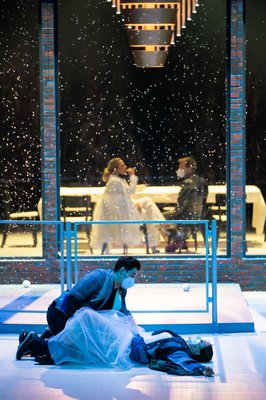
Dozens of people are placed in quarantine due to the harsh weather. Passions run high: those who should not fall in love do so, while those who ought to form a couple fall out of love. In confinement, many things are revealed about one another, and instead of a cancelled carnival wedding, a days-long quarantine party begins. Ede Poldini’s comic opera, premiered in 1924, returned to the OPERA repertoire in 2022 after a fifty-year hiatus. The recent pandemic had cast the piece in entirely new colours: a series of moments and states of mind familiar to all of us unfold, allowing us to laugh at ourselves and at how we spent that period locked within four walls.
Events
Premiere: Feb. 19, 2022
Synopsis
Part One
Scene 1
Zsuzsika’s family, her entire household is busy preparing a huge feast to celebrate her engagement. They are waiting for the arrival of the groom, Jónás Bükky. Zsuzsika is the only one not taking part in the preparations, as she does not like one bit the boy whom her mother, the mistress of the house chose for her. Another unforeseeable event hinders the mistress’s plans: there is a heavy snowfall, the roads are blocked, and none of the invited guests managed to get through the snowdrifts. But there are other, half frozen travellers stopped by the weather, who are taken in by the hospitable household. Among these random guests is Kálmán, a student from Csurgó, whose happiness takes over everyone almost instantly, chasing away their worries. A great feast begins.
Scene 2
Meanwhile, Kálmán keeps seeking the company of Zsuzsika. The girl escapes his attempts more for the sake of propriety. Finally they meet, and their love is fulfilled. But the love poem of the student is found by the mistress, who instantly calls her husband telling him that it is time he ended this intolerable situation and made Kálmán leave the house. At this point Péter loses the patience he has had until now, and confronts his wife: no guest may be insulted in his house! The mistress reacts by changing her tone and tactic. She had noticed that the army officer Zoltán keeps wishfully following the sorrowful Countess. She asks the Countess to keep Kálmán busy, while making Zoltán promise that he will entertain Zsuzsika all evening.
Part Two
Scene 1
The loving hearts have found a way to each other, and when Zsuzsika’s mother steps into the room again, she finds the original couples paired up. She suddenly invites all the guests into the room to see how the lovers broke their given word, and here begins the most exciting part of the game of forfeits previously started in the next room: the paying of forfeits. When the merriment is at its highest, they get the news that the snow has stopped falling and the roads can be used again the next day. The guests, who not so long ago were inconsolable for being trapped by the snow, now are just as sad for being able to move on. Upon Kálmán’s suggestion, they have a farewell party on their last night spent together, when forfeits and kisses flow freely.
Scene 2
Mrs Bükky finally arrives the next morning, but without her son, Jónás. As it turns out, Jónás has had his engagement after falling in love with their host’s daughter in the house where they got trapped by the snow. This time the mistress is happy to see Zsuzsika and Kálmán together. She takes the opportunity and introduces the student to Mrs Bükky as Zsuzsika’s fiancé, so as not to seem like a loser. The young lovers joyfully embrace each other, but they soon have to find out that the mistress only said what she said to keep her dignity in front of Mrs Bükky. In the end though she lets go of her stubborn disapproval of their love, and Zsuzsika and Kálmán can finally be together. They ask the guests who are about to leave to stay a little longer and celebrate the engagement for real this time.
Media
Reviews
“Above all, the story is funny, witty, and entertaining. It feels as if we were watching a film comedy from the 1930s, and we are not disappointed.”
Rolf Fath, Opera Lounge
Opera guide
Introduction
Cheese with more holes than cheese itself: this is what Hungarian opera literature may seem like at first glance, with entire periods and genres apparently missing from it. Unfortunately, this impression is not entirely unfounded, yet the overall picture can be nuanced, and even improved. For it was not only Erkel, followed by a long pause and then Bartók and Kodály; there were also numerous composers who appeared in the repertoire with one or more works, even achieved success, but were later consigned to oblivion by changing tastes, political upheavals, and the greater drawing power of bigger names. Hungarian operatic public opinion, which often seems reluctant even about Erkel, has difficulty coming to terms with the idea that lesser creators, too, deserve their place in the sun, that is, on the playbill. Yet if the Germans occasionally revive Lortzing, the Italians Montemezzi, or the French Lalo, then surely it would not be pointless for us to explore the smaller values of our own operatic heritage.
It may seem somewhat piquant that this point is being emphasized precisely in connection with Love Adrift (Hochzeit im Fasching), since this comic opera, although highly successful in the 1920s, may already have appeared anachronistic – or even outright reactionary – in its own time. After all, in the immediate contemporaneity of Bartók and Kodály, Poldini created merely a “Hungarian-style,” even Hungarianesque, musical stage work whose essential and admittedly nostalgic milieu is none other than a hospitable noble manor house. Nearly a hundred years later, however, we can truly afford the luxury (and the gesture of fair appreciation) of regarding this opera as a charming and harmless curiosity, one that poses no threat either to Háry or to Hungarian musical taste. And even if the charm that characterizes Poldini’s most successful work may feel somewhat affected, Kálmán’s student song, with all the hallmarks of the Hungarian art song, nevertheless remains a reliably rewarding tenor number. The biedermeier atmosphere of the opera as a whole can pleasantly lull us into contentment even as we are well aware that, strictly speaking, the stylistic label would justify the addition of the prefix ‘neo’. Let us relax. Love Adrift certainly does not compel us to search for hidden meanings, even if, up on stage, the mistress’s bunch of keys is feverishly sought for quite some time.
Ferenc László
Everyone is equal when locked in together – The director’s thoughts
A small company is trapped by the foul weather. Passions boiling, many things are revealed in this confinement, and instead of the engagement celebrations originally prepared, a lock-in party lasting several days is held, in which the motley company gradually turns into a community, and watches with great curiosity the forbidden love of the student from Csurgó, Kálmán, and the sensitive yet rebellious Zsuzsika. Meanwhile, others find love too of course, they eat everything they can find in the house, they party all night long, until everything gets sorted out at the end of the lock-in.
Love Adrift used to be “the Hungarian comic opera” once, but then it was forgotten, and a thick layer of dust has covered it. Still, in a sad way, this opera is relevant today, giving new shades to its label of being “comic”, adding a new layer of meaning, new ideological and emotional content to it: the lock-in caused by the snowstorm is a kind of quarantine situation, reminding us of the lock-down caused by the pandemic that has been defining our life too. The adaptation for the current production of the Hungarian State Opera is based on the psychological experiences of the present, changing the motives of the characters, turning the masses and huge choral scenes into a chamber play with six characters, adding a bit of extra with surreal figures. As a kind of counterpoint to the comic setting, the sad story of the almost Chekhovian, melancholic romance of the Officer and the Countess gets new emphasis. And the character of the mistress represents almost every psychological symptom that this depressing period brought us. Her marriage is all but ruined, the rebellion of her daughter almost gets physical, which might make us laugh, but the conclusion is not entirely joyful.
András Almási-Tóth