
Nabucco
Details
In Brief
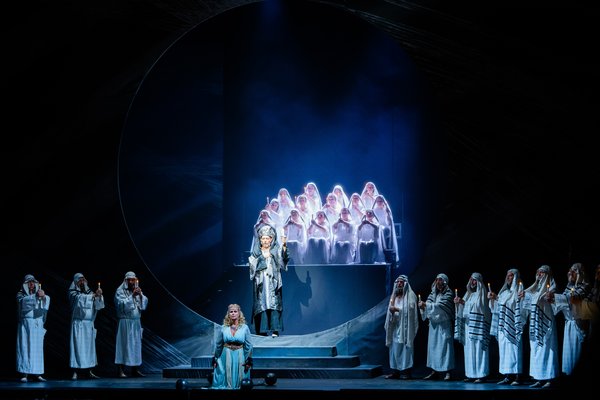
At age 27, Verdi resolved to never write opera again. He was at a low point in his life, both professionally and personally: His comic opera, Un giorno di regno, had failed, and around the same time he had to bury his two young children, and then his wife. After some convincing by his agent, he read Solera’s libretto, Nabucco, and by spring of 1842, all of Milan was humming “Va, pensiero...” The central point of the opera stands at a historical crossroads: value systems are changing and life is coming under the control of interrelationships starkly contasting previously in place. In the crosshairs of this conflict between vanquisher and vanquished unfolds a family drama in which the music of the Italian master leads the listener through the entire range of possible emotions. The production lifts the story out of the biblical era and places it into the realm of the cosmic.
Parental guidance
Events
Premiere: Nov. 7, 2025
Synopsis
Media
Reviews
“The twofold appeal of Nabucco presented in the new staging lay in the fact that it wanted to please everyone: the big tableaux with period costumes depicting well-known historical events favored those who liked traditional performances, while its abstract scenery and modern visual world attempted to capture the imagination of those who were not necessarily interested in seeing the copy of a 19th-century opera production.”
Veronika Hermann, Dívány.hu
“Kesselyák’s concept of returning to God, of faith, of the new world order born from these ideas, and of the laws of the universe abstracts itself from the narrative, yet it does not strip away the stylistic characteristics of the period prescribed by the libretto. Although it appears to historicize, in reality the approach is deeply spiritual, which comes across not only in the stage design with its gigantic impact (set designer: Edit Zeke) or in the spectacular costumes (costume designer: Janó Papp), but also in the music.”
Eszter Veronika Kiss, Mno.hu
“The new Nabucco, which premiered in Budapest, will probably be liked by everybody who likes musical theatre to be precise and meticulous.”
Yeri Han, Das Opernglas
Opera guide
Introduction
If Nabucco had been Verdi’s very first opera rather than his third, the story would undoubtedly be even more beautiful—but even so, it is far from unattractive. Identifying and naming Rossini’s or Donizetti’s third completed opera would not even be easy (of course, they began their trade earlier), whereas Nabucco has been an unbroken hit from its premiere to this very day. Moreover, it is a work in which, paradoxically, even the roughness and the imitation unmistakably bear the marks of the personal Verdi style that was just coming into being. The scheme with the threatened Jews, the foreign tyrant, the love plot crossing the front lines, and the oratorio-like character that surfaces here and there—this could all also be said of Rossini’s Moses, and the melody of the Chorus of the Hebrew Slaves can, in places, be heard echoing from a passage of Lucia di Lammermoor. And yet, here already (almost) everything is something entirely different: Nabucco is a work with aggressive attacking force, nowhere and never over-refined, hungry for strong impact and noisy success.
At the historic moment of its Milan premiere, this opera created the opportunity for a great, life-defining encounter: between the young Maestro, who had only half managed to shed his provincialism, and the Italian audience searching for a new, combatively loud and energetic voice. That the Italian sons and daughters of the Risorgimento could identify their own oppressed situation and impending struggle with that of the Jews enslaved by the (new) Babylonian ruler is a much-cited and true commonplace, but it does not answer the question of why Nabucco still affects us so directly 180 years later. Perhaps, one might say, because Verdi was bold enough to place operatically scaled yet convincingly real monsters at the centre. The title character who proclaims himself a god, the immeasurably power- and revenge-hungry Abigaille, and even Zachariah, who exists solely as a high priest and is ready to sacrifice innocent blood for his community, all are uncomfortable and at the same time uncomfortably familiar types.
Then there is also the sense of purpose that may well impress posterity, with which the composer, in an unusual but well-judged way, pushed the love plot entirely to the periphery: although the librettist Solera had drafted a large duet in advance for Fenena and Ismaele, Verdi rejected the proposal. “Nel dì della vendetta / chi mai d’amor parlò?”—that is, on the day of vengeance, who would speak of love? Characteristically, Fenena’s solo begins with this very line, after the first twenty minutes of the opera have passed without our hearing a single fleeting personal utterance. All the more – and larger – a role is given here to the community, that is, to the chorus: long before the “Va, pensiero” is sung, now trembling in fear of utter doom, now imploring Jehovah, now cursing and casting out the presumed traitor. And when, in the third act, this famous chorus finally arrives, no matter that we have encountered it countless times before and may recognize at first hearing the shamelessly direct mechanism of its effect – the long melodic arc, the Larghetto tempo, the triplet pulse – it nevertheless proves time and again to be the shared enchantment of inexhaustibility and pathos, just like every performance of “Casta diva”.
Ferenc László
Nabucco in view of the succession of world-historic eras – The director’s thoughts
Operas in general were a passive experience for me, I got to know them from the radio, from here and there in my childhood. It was the same with Verdi, too: I didn’t speak Italian, I didn’t know what they were singing about, but looking back, I have to say, I perfectly understood what the music actually wanted to say, without understanding a word from the text. Even without knowing the lyrics, Verdi’s music reflects the monumentality that, in my view, draws attention to the succession of ages in history. This is relatable to me in this day and age, and it also shaped my directorial concept, as many of us feel that we are in a similar shift of eras to what Nabucco’s story is about, and this transition has a kind of cosmic structure and background. According to the theory of the succession of eras, these transitions come to happen approximately every two thousand years.
2000 years Before the Common Era, the fall of the Assyrian Empire brought about the time of the Old Testament: according to historical astrology, Earth entered the epoch of Aries and left that of Taurus. Then, another two thousand years later, the birth of Christ brought about the time of the New Testament (going from the epoch of Taurus to the epoch of Pisces), while today the astrologists await our transition into the age of Aquarius. History goes along its own course for a time being, then when changes start to compress and condense, it gets stuck a little. At these times, there is more tension than usual, there is more conflict between people and when these eventually smoothen out, like at the end of Nabucco, our world temporarily comes to a consensus. This opera is about faith, and I believe the lack of choruses clashing is the strongest musical evidence for the fact that it is not about conflict between people or religions, but the common prosperity of mankind. (In contrast with the musical structure of I vespri siciliani, for example.) From this perspective there aren’t any positives or negatives, there is only old and new energy: our job is to understand where our world is headed, to trust the changes of the cosmos in order to find the path that leads us to God.
Gergely Kesselyák