
Spartacus
Details
In Brief
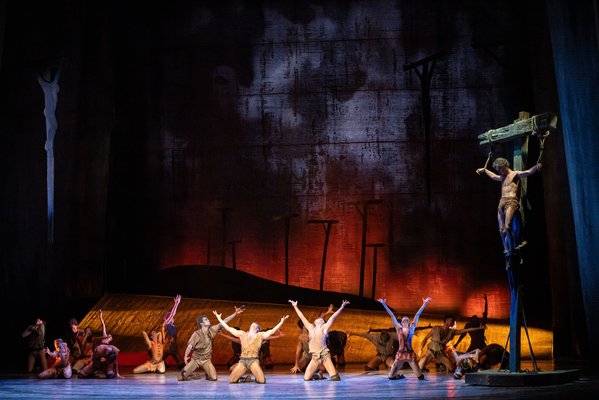
Set in the Roman Empire around 74 BC, Spartacus was László Seregi's first true full-length ballet, which at one stroke became a milestone in Hungarian dance life. Since 1968, one generation after another has enjoyed the historically themed choreography, which treats the story of the ancient slave revolt in such a way that its true message is not the rebellion itself, but rather human emotions and choices under pressure. “The subject will remain an eternal one for as long as people are being tormented, killed and treated unjustly, and for as long as there are people who wish to break free.” (László Seregi)
Parental guidance
Events
Premiere: May 18, 1968
Synopsis
Media
Reviews
“In Seregi’s choreographic, directorial, and dramaturgical concept, traditional narrative construction alternates with the modern spirit’s ‘play with time,’ the recalling of memories, just as, in the dance itself, the classical dance language alternates with the expressive means of modern ballet and pantomime. Naturally, Seregi placed the main emphasis on the dense, at times almost bursting dramatic atmosphere; the performance contains an exceptionally large number of powerful, attractive moments that elicit spontaneous applause, while individual dancers are also given their appropriate roles and opportunities.”
István Albert, Film – Theatre – Music
"The ballet Spartacus is nothing if not a spectacle. The enormous cast, the dramatic love story, the tragedy and Aram Khachaturian’s score are components enough. Give it a live orchestra (...), the Hungarian National Ballet and a venue like the Hungarian State Opera House in Budapest and it’s difficult to imagine anything other than splendour."
Deborah Weiss, Bachtrack
Ballet guide
The ballet’s historical background
What did it mean to be a slave in ancient Rome?
The Emperor Justinian summarised the institution of slavery as follows: “Slavery is an institution of the law of nations, subjecting, against nature, one man to the dominion of another. The name ‘slave’ is derived from the practice of military commanders of ordering the sale of captives, and thereby saving them instead of killing them; hence they are also called ‘mancipia’, because they are seized from the enemy by the hand.” Wealthier Roman citizens might possess up to 500 slaves, and Roman emperors often had as many as 20,000 of them. The Roman army was the most important supplier of slaves, but Roman laws made it possible for fathers in difficult financial straits to sell their children into slavery as well. After individual military campaigns, tens of thousands of prisoners might wind up on the slave markets. Slave traders did not try to trick their buyers: slaves were usually sold and bought naked so as to assess their physical abilities more easily. Slaves with a good knowledge of the culinary arts fetched extremely high prices. If a slave fled, professional “slave hunters” were hired to find them. After capturing runaway slaves, the letters FUG (for “fugitivus”, that is “runaway”) were burnt onto their foreheads.
Gladiatorial combat
Some slaves were forced to entertain their masters by fighting each other, and in some cases they had to fight wild animals. The first official such fight to the death was held in 105 BC. In order to prevent the gladiators from being killed right after emerging into the arena, they received training in gladiatorial schools. The first gladiators were prisoners of war captured during wars of conquest. Their names, for example, Gallus (Gaul) and Thraex (Thracian), were derived from their place of origin. These fighters were pitted against each other in the battlefield using the tactics and arms that were characteristics of their ethnic group, and the fights had a special “choreography”. The spectacle began with the procession, in which all of the gladiators who were about to fight participated. The gladiators arrived at the arena in opulent and colourful attire. They made a lap of honour in the arena, marching before their master’s or the emperor’s box. Who would fight whom was determined by the drawing of lots. The libellous numerarius was the “programme booklet” of the gladiatorial games, with the list of fighters who would be entering. The weapons were checked: every sword, harpoon and arrow was carefully examined. Nets were also used, for immobilising the enemy. Trumpets signalled the beginning of the fight, which lasted until one of the fighters was dead. Then, according to tradition, a servant dressed as Charon, the ferryman of the underworld, appeared in the arena, walked over to the corpse and hit it with a stick, showing that he was now the owner of the body. The winning gladiator proceeded to the ruler’s box to receive his prize, a palm leaf, the traditional symbol of victory, together with several golden coins, and then, before leaving the arena to the applause of the audience, he made a lap of honour. Gladiatorial games became a tool of political propaganda for emperors: they enhanced the emperor’s popularity and appeased the masses (“panem et circenses”). The games were held up until the 5th century AD, when they were officially banned.
The historical Spartacus
Over the centuries, the figure of Spartacus, leader of the rebelling slaves, grew into a legend: he became a symbol of rebellion against injustice and of a man who does not give up fighting even when victory seems hopeless. In the spirit of the ideology of “class struggle”, political movements used his name on their banners or even appropriated it for themselves; his admirers included Garibaldi and Che Guevara. Books, films and statues have been created about him. But what was the “real” Spartacus like? Spartacus (109 – 71 BC) was a gladiator and slave of Thracian origin in ancient Rome. Being the leader of the greatest slave uprising that broke out in 73 BC, he was a significant male figure in history. Previously, over the course of the second century BC, several slave uprisings had already broken out. Thousands of slaves rebelled against their masters, protesting against the inhuman conditions they were forced to live in, since their owners often physically maltreated them and punished them without cause. These uprisings were suppressed by the Roman army, and the rebels were crucified. Spartacus was trained in Capua, the centre of gladiator training in the Roman Empire. His talent was evident even during the training. There was almost no possibility for gladiators to organise resistance, but Spartacus managed to establish some kind of a bond among them, and succeeded in breaking out of the gladiator barracks with more than seventy men. The Spartacus uprising is a historical event. A number of uprisings broke out around the Empire, but none of these were as important as the greatest one led by Spartacus.
Historical figures in the ballet
In 73 BC, the slaves in the gladiatorial school in Capua run by Lentulus Batiatus rose up and broke out of the barracks in order to change their hopeless fate for the better. Spartacus, the leader of the uprising, fled to the woods on Mount Vesuvius. Initially, their weapons consisted of basic kitchen utensils. Hearing the news of their escape, the slaves working in the manors nearby also joined the rebels. The army of slaves successfully fought the Roman legions that were sent against them, stoking fear among the Roman aristocracy. News arrived about masses of slaves rebelling against their masters and running away from them. The revolutionary mood increased as Spartacus’s army racked up victory after victory against the Roman legions. The Senate, which consisted of large landowners, eventually decided that it had had enough of watching its troops being defeated while the rebels grew in strength, and gave unlimited power to the wealthy Marcus Lucinius Crassus, commander of the Roman legions. Crassus was also a historical figure. Whether Spartacus was married or not is the subject of many different stories. According to Plutarch, Spartacus’s wife was from the same tribe as himself and they became slaves together. However, only a few sources mention her.
Spartacus in the arts
Spartacus’s legacy has been preserved in art as well. Many writers and poets have passed him and his story down for posterity: Cicero, Horatius and Lucanus and others all wrote about the slave leader. The ancient sources on the uprising (by Plutarch, Appianus, Florus, Orosius and Sallustius) all commemorate his personality as well. Later on, numerous other authors also wrote about the events of the uprising or the character of the heroic slave leader. The most popular of these is Howard Fast’s bestselling book Spartacus, which has served as the basis for many stage and film adaptations. The success of Fast’s novel was mainly due to its modern approach and tone. The author powerfully depicts the slave-holding society in its heyday, the suffering of the slaves, the colourful and purchasable rabble of the plebeians, the dandified group of equites and soldiers, the swaggering landlords, the politicians and the completely depraved Senate.
The most important film, the script of which was based on this book, is perhaps Stanley Kubrick’s Spartacus, featuring Oscar-winning actor Kirk Douglas in the title role. The film was premiered in the United States in 1960. It shows the life of Spartacus and the story of the Third Servile War. It also includes Peter Ustinov in the role of Lentulus Batiatus and Johan Gavin as Julius Caesar, with even Tony Curtis making an appearance on the screen. It is not only in books and films that the life and deeds of one of the greatest slave leaders in history has been recorded. A number of fine artists have also been inspired by Spartacus’s greatness. One of the most important monuments is French sculptor Denis Foyatier’s (1793–1863) statue of Spartacus from 1831. More than two metres high,the marble statue was part of a group of eight figures, and has been at the Louvre since 1877. Less famous is the marble The Oath of Spartacus, sculpted by Louis-Ernest Barrias (1841–1905). Hungary too can boast a statue of Spartacus: the bronze statue of 2.4 metres in height was created by Barna Megyeri (1920-1966) in 1955, and it can be found in the 14th District of Budapest, outside 78 Kerepesi Road. It bears mention that there was also a Hungarian play inspired by the story of Spartacus: Hungarian playwright Gergely Csiky wrote his historical tragedy in verse in five acts titled Spartacus in 1875. It was premiered at the National Theatre in Budapest in 1886.
A large number of Spartacus ballets have also been created. Seregi’s dance drama was preceded by 18 different choreographies. All tried to present the most important events and moments of the uprising faithfully to the viewers. Some dance versions were at the time compared to cinematic treatments, although the situation of a choreographer is usually more difficult than that of a film director. The choreographer has fewer tools to work with, and must work in real time, without tricks or effects that can only be used on the film screen. There is an advantage, however, in the fact that the viewer may grow more intensively involved in the events in the theatre while listening to live music than while sitting in front of a projection screen. These are the difficulties and issues that choreographers deal with the subject have had to face. The most important productions before Seregi’s were created by L. Yakobson (1956), J. Blazek (1957), I. Moiseyev (1958) and J. Grigorovich (1968). The most important ones to follow Seregi’s were those of M. Abbondanza (1987), György Vámos (1989), J. Grant (1989) and W. Orlikowsky (1989). The ballet productions preceding the Hungarian Spartacus were conceived almost solely on Soviet stages. Of course, there were fundamentally ideological reasons for this, since who could present better the figure of the revolutionary who emerges from the lowest layers of society and makes himself into a hero than the slave commander from antiquity? A forerunner of this type of ballet was a Soviet classical ballet premiered in Paris in 1932 titled The Flames of Paris (Asafiev – Vainonen), which used the theme of revolution to pay tribute to the ideal of Soviet heroism that prevailed in the era. Until the 1980s, the narrative ballet drama (“dramoballet”) had an almost exclusive place on Soviet ballet stages, all featuring a large number of characters, spectacular crowd scenes and variations and pas de deux that were technically difficult to dance.
The Hungarian world premiere
László Seregi’s Spartacus, set in the Roman Empire around 74 BC, was his first true grand ballet, which became an instant milestone in the history of Hungarian dance, and each generation since 1968 has enjoyed its historically themed choreography, which treats the story of the ancient slave uprising in the ancient Roman Empire while also delivering its true message about revolution and the human emotions and decisions that arise during periods of oppression. “It will be an eternal theme for as long as people are being tortured, killed and hurt unjustly, and for as long as there are people who want to break out of this,” claimed the choreographer. In 1968, László Seregi was working on the premiere at the Opera simultaneously with the preparations being made in Moscow for the premiere of Grigorovich’s production. The Budapest premiere was held on 18 May 1968, not long after the one in Moscow. Of course, preparations had begun a year earlier.
In 1967, the management of the OPERA decided to commission László Seregi to create a ballet with a revolutionary theme. The general director of the OPERA, Miklós Lukács, summarised his ideas to Seregi: he should find a theme about social struggle, including the concept of suppression and liberation. Coming more than ten years after the Hungarian revolution of 1956, with the country still part of the Soviet Bloc, this undertaking must have been a sensitive one. Lukács suggested the story of Spartacus and the above-mentioned book by Howard Fast as a good potential starting point for creating a ballet. Seregi had read this book as a child, and it had affected him greatly. Now he would have the opportunity to adapt the story for the stage. Thus far he had choreographed ballet interludes of various lengths, and Spartacus would become his first full-length ballet. Together with assistant choreographer Ildikó Kaszás, he set to work creating the ballet. For the music – just as in Moscow – they chose Aram Khachaturian’s ballet music Spartacus. When Seregi was given the score of Spartacus, he and conductor Tamás Pál immediately set out to completely revise both the music and the libretto by Nikolai Dimitriyevich Volkov.
Seregi was well aware of the fact that it would be impossible to bring the entire historical background to the stage, and he thus focused only the most important moments and events of the uprising. Still, he managed to present a coherent story on the stage. He had an excellent sense for this, as well as for depicting characters. He tried to create figures in a way that made them credible to the audience. These were the factors that he was considering when he was creating the characters of Flavia, the gladiators and the other heroes. He imagined Spartacus as a simple and fallible person, nobody special who is not a hero at all, but who is chosen by fate and made into a leader by the situation. A slave who can frighten Rome. “I knew that in order to make a drama from real life into a drama on the ballet stage, the only way to get there was through the characters and the specific situations; I can only express it with feeling and suffering people who have been humiliated and violated, and now yearn to rise up and rip off their chains. This was my objective, and I think this is what makes this piece enjoyable even today.” It is a typical feature of Seregi’s choreographies that he liked to have many characters moving around on the stage at once. The crowd became an element of the set, and, at the same time, it also made a given piece more credible. Perhaps László Seregi’s background as a folk dancer played a role in this.
Seregi paid attention to every detail, including the set and costume design. The memories of the few years he had spent at the College of Applied Arts were not forgotten. He himself conceived of what he wanted to see on the stage, drafted the plans and designed everything that was necessary to realise the work, and then discussed them with the designers, who then only had to deal with implementing them. He dreamed up wonderful sets for his first full-length ballet, which included the Via Appia full of crosses bearing the suffering, defeated slaves as they await their deaths and the depiction of the gladiatorial school in Capua. Crassus’s palace also faithfully reflects the Roman era. In his Spartacus, uniquely in the history of Hungarian ballet, Seregi summarised everything that was important in his own professional career and the ballet traditions of the OPERA up to that point: Harangozó’s legacy of the national style of ballet, the romantic realism and monumentality of Soviet ballet dramas, and the primeval force and noble pathos of the style of Hungarian dramatic folk dance (military dance).
The composer and his work
The music to Spartacus is extraordinarily supple, perfectly suited for film. Khachaturian composed the music to Spartacus 12 years after that of Gayane, meaning that a major difference can be observed in the artistic treatment of the two works. In the case of the later work, the creative process lasted three and a half years, and the composer travelled to Italy in order to study ancient statues and pictures on site. While in the music for Gayane, the closed numbers and the musical passages forming the background for the stage drama and pantomime that linked the dances together were loosely connected to each other, the music for Spartacus is in its entirety dramatic ballet music composed from start to finish with symphonic precision. Here, it is not in evoking the tunes to folk dances that the Armenian national character emerges, but primarily in the rich orchestration of the colourful scenes. Khachaturian depicts robustly crafted characters – heroic men and feminine women – to produce an impressive illustration of the dramatic tension and tragic failure of the slave uprising.
The music for Spartacus was not discussed in advance and jointly developed with the ballet master according to some compositional plan. This established method was eschewed by Khachaturian, which is why later on, each time the ballet was staged, the music underwent significant omissions and re-orderings, and the ballet masters were even known to ask the composer for new insertions. Khachaturian would protest, passionate arguments would ensue, but in the end, he would make the revisions. “I consider the ballet to be a great art form. All the variety of human life and the wealth of its moral lessons can be expressed with it. It’s important for the music to be able to express all the beauty that can be seen on stage in the ballet,” said the composer.
It was not on the ballet stage where the music for Spartacus was heard for the first time, but instead on two pianos, in the Leningrad House of Composers in 1954, and later on in the form of a suite as interpreted by the Leningrad Radio Symphony Orchestra. The premiere at the Kirov Theatre on 27 December 1956 was preceded by enormous concert success. For that, the highly respected composer had to make the above-mentioned abridgements and significant re-orderings according to the thinking of Leonid Yakobson (1904–1975), and also had to compose three hours’ worth of music for the lengthy four-act ballet libretto by Nikolai Volkov. The Leningrad premiere was successful, but at the Bolshoi Theatre two years later, in 1958, spectacularly directed and choreographed by Igor Moiseyev, it did not achieve the desired effect. Khachaturian’s music was recognised with the Lenin Prize in 1959 and the Stalin Prize later on, and by 1962 it was being performed, in Moscow as well as elsewhere, in a shorter format using Yakobson’s choreography.
Finally, on 9 April 1968 in Moscow, Yuri Grigorovich’s choreography to Spartacus brought the ballet the longed-for success on the choreographic side as well. Grigorovich eventually realised that it was the intuitiveness of the dance that prevailed in Khachaturian’s score over the set compositional plan in how the dramatically rich scenes and lyrical episodes provide a rich melodic and dancably rhythmic basis for the choreographer’s imagination. The colourful, refined and later tragically grim harmonies of its orchestration actually enable both the designer and performers of the dance to give lyrical and dramatic nuance to the movements.
This is how it would be in Seregi’s case, as well. The Hungarian artist had definite ideas about how to mount the work and what dramaturgical solutions to use. This also necessitated revising the music. Because he had written a completely new libretto and completely altered the piece’s dramatic approach, Seregi had to work with conductor Tamás Pál to make abridgements and changes in order in the work that were similar to those of other artists who had previously mounted the work, although they were perhaps on a greater scale. The Soviet composer at first went along with this only with great reluctance, but would later speak appreciatively of it after seeing how successful the ballet had become.
The production was an enormous triumph: at the world premiere, featuring two superb soloists of the ballet company, Viktor Fülöp as Spartacus and Zsuzsa Kun as Flavia, the audience gave both the piece and the choreographer a 30-minute standing ovation. Both the composer and his wife were present for the occasion. Prior to the premiere, Khachaturian had still been upset that Seregi and his colleagues had completely refashioned the piece’s score. At the celebration following the performance, Khachaturian was ready to ban any further performances. But then he relented and gave his permission for it to be performed in Hungary, inside the Opera House, but not to be taken on tours abroad if it still included the musical revisions. After this declaration, he quickly departed. A year later, in November of 1969, the ensemble was invited for an international dance festival in Paris, to which they naturally wished to bring Spartacus. They therefore needed permission from Khachaturian, who eventually gave his consent for them to present the piece. It ended up being so successful that it won two Étoiles d’Or: one for best choreographer, the other in the best prima ballerina category, which went to Zsuzsa Kun for her portrayal of Flavia. László Seregi’s Spartacus has remained a tremendous international success since them, having been presented in many countries and prominent cities, including Paris, Rome (the Baths of Caracalla), Baalbek, Melbourne, Sydney, New York (the Metropolitan Opera), Athens, Santiago de Chile and Berlin. Influenced by the great interest and success, Khachaturian changed his mind and consented to having the piece continue to be performed internationally, and informed Seregi of this in a letter “Dear Seregi! Dear Opera House! I can’t tell you how glad I am that our joint work, our Spartacus, has been so successful. I naturally give my consent, and wish you much future success! Khachaturian.” The Australians were so smitten with Seregi’s Spartacus that they took it on tour to various stops, and even kept it on the repertoire in Australia for some years.
The ballet’s choreography
László Seregi’s choreography for Spartacus is the work of a mature artist. Coming to fruition in it is everything Seregi soaked up during his youth about folk dance, classical ballet and character dance, everything that he had taken in about the realistic Hungarian ballet tradition from his direct experience of the work of Gyula Harangozó at the Opera House, and all the ideas about a full-length Soviet ballet drama production that had filtered through him and ripened in him over the course of two decades. This cinematic vision, moreover, was a novelty on the Hungarian ballet stage, and he also used the lighting innovatively. His language of movement was essentially built on classical ballet, but frequently employed both elements from folk culture and acrobatics. The longer corps de ballet dances were invariably prominently positioned between two dramaturgically important moments. His solos and duets develop characters and convey emotions for the audience. Spartacus’s dance of vengeance in the first act, for example, contains the explosive passion of the slave uprising. But what is even more interesting than this is the work’s operatic nature, which with theatrical effects, also helps the viewer follow the plot.
By any measure, in terms of both emotion and atmosphere, the grand pas de deux of Spartacus and Flavia in Act Three is the climax of the ballet. This is where it becomes completely apparent that the rebels have lost, since the Roman legions, albeit with great difficulty, have put down the uprising. The slaves have lost this battle honourably. And yet, the duet is still about the two lovers, who sense that they are about to lose each other and their last chance to ever be together again. This anxiety and fear, the sense of bidding farewell, and the love, are palpable throughout the entire pas de deux. “In their tragically soaring pas de deux, Spartacus and Flavia make their irrevocable farewell into something uplifting, and the revolutionary expresses, along with his loyal love for his mate, his heroic sense of commitment, his compassion for his comrades, and his lamentations over the failed uprising.”
At the start of the duet, both of them are gazing at their fallen comrades, who had stuck with them to the end. The weary Spartacus then goes from one of his friends to the other, his conscience troubled by the fact that he had promised them their freedom, but in the end was unable to give it to them. Then he suddenly finds Flavia and is overcome by a kind of peace. This is where the lovers’ final dance begins. The tremendous lifts and movements encapsulate the suffering, love, and the yearned-for freedom. Spartacus attempts to use his body to shield Flavia from the emerging troops, who from every direction watch to see how they can approach them and tear them away from each other. When the troops break into the camp, chaos reigns: the lovers attempt to protect each other up until the last second, but the crowd thrusts Flavia away from Spartacus. Now they seek each other in vain: they will never meet again. Finally, Spartacus is captured by the soldiers.
Choreographically, musically and dramaturgically, this is the peak moment. Flavia’s brief solo depicts the near-delirium of her utter pain. Finally, weary and despondent, she slumps to the ground. In her exhaustion, she imagines that Spartacus is there beside her again. The vision does not last long: she returns to reality and is forced to accept that her love is no more. Before this, however, the choreographer depicts Flavia’s fantasy with poetic beauty. He also adjusts the lighting to correspond to the impact of the music and emotions. With dim lighting effects, he conveys the idea that it is only Flavia’s imagination that is bringing Spartacus back to her, and only for a few minutes. As the vision nears its end, the stage grows even darker, and Spartacus gradually vanishes. The music grows silent, and Flavia is left by herself. Using this technique, the artist shows how even though the legend and its flesh-and-blood characters belong to the past, their passion and suffering always remains ready to be brought back to life.
Rita Major