
The Fountain of Bakhchisarai
Details
In Brief
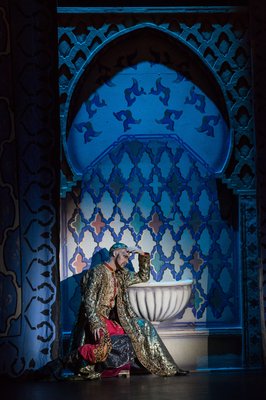
While the Fountain of Tears bubbles before him, Giray, khan of the Tatars, is lost in brooding. Just as the flow from the marble fount cannot be exhausted, his own sorrow will never diminish, either. The story of the Fountain of Bakhchisarai is set in motion by a romance recounting the reason for the khan's gloom. This work is one of the cornerstones of Russian ballet history, and since its premiere has enjoyed unbroken success as a representative of the genre of ballet drama, in which a dramatic performance is closely intertwined with the use of the classical language of dance and character dances. The choreographer of the work, Rotislav Zakharov, was powerfully drawn to Russian literary sources, making Pushkin's poem of the same title an obvious choice for his work, for which Boris Asafyev composed the music. The subject is a truly dramatic one: a story of jealous love. Giray, khan of the tatars has fallen wildly into love with Maria, whom he and his Tatars have abducted and forced into his harem just as she was preparing for her wedding. Zarema, the khan's first wife, does not take kindly to this situation. Tragedy is inevitable...
Parental guidance
Events
Premiere: April 29, 1952
Synopsis
Prelude
By the Fountain of Tears, Giray Khan reminisisces.
Act I
The park surrounding the castle of the Polish nobleman Potocki, where a birthday celebration for Potocki's daughter, Maria, is underway.
“Her form a thousand charms unfolded,
Her face by beauty's self was moulded,
Her dark blue eyes were full of fire,--
All nature's stores on her were lavished.”
The beautiful Maria has unsurprisingly already attracted a serious suitor: the youthful nobleman Waclaw. The garden party begins, and the guests begin to dance. The younger men vie to demonstrate their skill at arms, and then Maria and Waclaw also dance. Unbeknownst to all of them, however, the Tatars are lurking nearby. After the guests file into the castle, Maria and Waclaw are left alone in the garden for a few minutes to enjoy the sweetness of their blossoming love. The guests return, and just as the revelry reaches its peak, a mortally wounded knight appears to announce that the castle has been surrounded by Tatars.
“The Tartar's force
Rushed like a torrent o'er her nation,
Rages less fierce the conflagration
Devouring harvests in its course,
Poland it swept with devastation.”
The Tatars slaughter the men defending the castle and carry off the women. Waclaw valiantly rescues Maria and is about to slay Giray, but with a lightning-fast movement, the battle-hardened khan stabs the young man in the heart. Only then does he notice Maria, frozen in fear. Ripping off the white veil that covers the girl's face, Giray is instantly bewitched by her remarkable beauty. Inflamed in his wild Tatar soul is a passion like nothing he has ever experienced...
Act II
The harem in Giray Khan's Bakhchisaray Palace
"The captives pass their joyless hours.
The youngest seek, indeed, reprieve,
Their hearts in striving to deceive,
Into oblivion of distress,
By vain amusements, gorgeous dress,
Or by the noise of living streams,
In soft translucency meand'ring,
To lose their thoughts in fancy's dreams,"
The khan's first wife, Zarema, has painstakingly groomed and dressed herself and now awaits the great lord's return from afar. The Tatar horde arrives, and Zarema sweetly greets her husband with cajoling desire. The khan, nonetheless, acts stiff and dismissive towards her. With the captive Maria, however, he behaves quite differently, even going so far as to obsequiously offer her his palace. Maria is pure and innocent. She rejects the khan and withdraws. As Giray broods, Zarema is thunderstruck and devastated. The eunuchs attempt to alleviate the atmosphere by having the girls dance, but to no avail. Zarema refuses to give up: the khan's love means the world to her. She summons up all her power and passion to regain Giray's attentions, but there is no room for her in her beloved man's heart. Her humiliation is compounded when the other women in the harem, usually envious of her, laugh spitefully at her woe.
Act III
Scene 1
Maria's room
“The Khan to her such freedom gave;
But rarely he himself offended
By visits, the desponding fair,
Remotely lodged, none else intruded;
It seemed as though some jewel rare,
Something unearthly were secluded,
And careful kept untroubled there.”
In her solitude, Maria dreams of her lost freedom and happiness. Giray visits her to passionately declare his love and ask for hers. He advances on her relentlessly, but the girl will not submit. Then the mighty khan retreats: he bows down before her and leaves her alone.
"The women sleep; --but one is there
Who sleeps not; goaded by despair
Her couch she quits with dread intent,
On awful errand is she bent;
Breathless she through the door swift flying
Passes unseen; her timid feet
Scarce touch the floor, she glides so fleet.
In doubtful slumber restless lying
The eunuch thwarts the fair one's path,
Ah! who can speak his bosom's wrath?
False is the quiet sleep would throw
Around that grey and care-worn brow;
She like a spirit vanished by
Viewless, unheard as her own sigh!”
Zarema eludes the guards and sneaks into Maria's room. There, she begs for the Polish girl to return her beloved to her. Maria calms her down, but Zarema spots Giray's cap, which has been left there. Believing that she has been tricked and enraged with jealousy, she draws a dagger and stabs Maria. The khan arrives, but it is too late. Consumed with boundless fury, he raises the dagger at Zarema, but does not kill her.
Scene 2
The rooftop of the khan's palace. Giray is inconsolable. Zarema is led in by the guards, and at a gesture from Nurali, Giray's sub-commander, is cast from the parapet to the ground far below.
“The fair Grusinian now no more
Yielded her soul to passion's power,
Her fate was with Maria's blended,
On the same night their sorrows ended;
Seized by mute guards the hapless fair
Into a deep abyss they threw,--
If vast her crime, through love's despair,
Her punishment was dreadful too!”
Nurali and the Tatar warriors attempt to lift the sullen khan's spirits with a wild dance.
Epilogue
At the Fountain of Tears, Giray Khan reminisces, seeing the figures of Maria and Zarema in his imagination. For Giray, love died along with Maria, and hope has vanished forever...
And the fountain?
“Th'inscription mid the silent waste
Not yet has time's rude hand effaced,
Still do the gurgling waters pour
Their streams dispensing sadness round,
As mothers weep for sons no more,
In never-ending sorrows drowned.”
(The excerpts from Pushkin's story in verse The Fountain of Bakhchisarai were translated from the Russian by William D. Lewis.)
Media
Reviews
“The ballet company takes to the stage with tremendous enthusiasm. The splendid set design and the noble costumes make the outstanding performance feel completely whole. This is a production that is definitely worth seeing, presented on stage in a truly captivating way.”
Ira Werbowsky, Der neue Merker
Ballet guide
Literature on the ballet stage
Using a work of literature as the basis for ballets has a long history. Poems, plays and mythological stories had all provided inspiration since the Renaissance, but the appearance of ballets with a plot – credited to one Jean-Georges Noverre – only occurred in the second half of the 18th century. In this era, it was mainly mythological works that were staged, which starting in the 1820s and the onset of the age of Romanticism, were replaced with subjects from fairy tales and sometimes love stories combined with exotic oriental features. Having a novel-like quality – part of the meaning of the term “romanticism” – also implies that a ballet can be created to almost any interesting work of art that was considered to be suitable for expression in the language of dance. This is how ballets were created to works by such great authors as Shakespeare, Lord Byron (Le Corsaire) and E. T. A. Hoffmann (The Nutcracker and Coppélia) and even Pushkin.
The Russian author was almost as popular with librettists and choreographers as the Bard of Avon was. It is only a slight exaggeration to state that most of Pushkin’s dramatic works have had a ballet or some other kind of dance piece composed to them. Some of the most important ones include Onegin (John Cranko, 1965), Ruslan and Lyudmila (Adam Glushkovsky, 1821), The Prisoner of the Caucasus (Charles-Louis Didelot, 1823), Le Poisson doré (Arthur Saint-Léon, 1867), The Queen of Spades (Serge Lifar, 1960, and Roland Petit, 1977), and The Bronze Horseman (Rostislav Zakharov, 1949) – as well as The Fountain of Bakhchisarai, which was first adapted for the stage by Foma Nijinsky, father of the world-famous Vaslav Nijinsky, in 1892. Pushkin began to write his narrative poem in 1821 after being inspired by his visit to Bakhchisarai in the Crimea while he was in exile. In the palace, situated in the middle of the Tartar Khanate, there was a monument named the “Fountain of Tears”. He finished his work in 1824, and it was published in the same year.
The Fountain of Bakhchisarai was premiered on 28 September 1934 in Leningrad, formerly known as Petrograd, and even earlier as Saint. Petersburg, as it is again known today. The venue of the premiere was the former Mariinksy Theatre, which now bears this same name again, but in 1934 its official name was the Academic Opera and Ballet Theatre, although most people probably know it as the Kirov. The many changes in name clearly show that The Fountain of Bakhchisarai was conceived in an era when radical changes were taking place over a very short span of time. In order to better understand the ballets of this era, we have to travel back in time. At the end of the 19th century, the Russian ballet stage was still dominated by the classicism of Marius Petipa, and by Swan Lake, The Sleeping Beauty, La Bayadère, Don Quixote, and further lavish works, but by the early 1900s, signs of change were becoming evident both in classical ballet and the tsarist political system. In dance, these took the form of the innovations of Alexander Gorsky and Mikhail Fokin, and in politics, those of the revolutions of 1905 and 1917 and, in the meantime, the First World War. After the October Revolution, ballet suddenly faced an existential threat: with the collapse of the tsarist system, there was no one to maintain the schools and the costly theatres any more, and even the size of the audience and the number of dancers diminished.Eventually, however, through the intervention of People’s Commissar of Education Anatoly Lunacharsky, ballet was not banished from Russian culture. Only the audience was replaced, by workers, who had in theory become the ruling class. The early 1920s were the heyday of the Soviet avant-garde, which soon vanished in parallel with the establishment of a dictatorship. Progressive artists either left the country or were imprisoned or silenced. It was during this era that the genre of dramoballet was born. These are usually ballets of multiple acts, which were conceived in the spirit of socialist realism. The works were characterised by spectacular crowd scenes, grandiosity, heroism and sometimes deliberate ideological content.
Being dramas with dance, the stories had to be understandable even by the simplest audiences, and this genre expressed the conflict between good and evil at the social level, with a strong ideological approach. This is how Flames of Paris, which presented the events of the French Revolution in the spirit of class struggle at the premiere in 1932, was conceived. In Fyodor Lopukhov’s 1931 ballet The Bolt, the story revolved around a planned act of factory sabotage in a factory and how it was thwarted. There were also ballets titled The Serf Ballerina and Red Whirlwind. After a while, as the pieces of the Romantic/Classical repertoire were continuously re-choreographed, the dramoballets began to move away from political topics, which can mainly be explained by the Stalinist terror. In order to minimise the risks, creators of ballets began to turn to literary themes, in which it would have been more difficult to interpret and present ideological content wrongly. Of course, this did not automatically mean protection from ideological attacks. It was during this politically oppressive era that The Fountain of Bakhchisarai was conceived.
In terms of form, these ballets continued the dramaturgical traditions of classical ballet: they consisted of several acts, with many ornamental dances being presented on the stage, but at the same time, they also reflected the expectations of their own era as the choreographers emphasised the great dramatic conflicts, and the characters were carefully built up and analysed during the rehearsal process. The example was borrowed from Konstantin Stanislavsky’s method in spoken-word drama. Visually, the ballets could only be realistic: no abstraction was allowed on the stage, because it would have led to immediate retaliation.
It was in this depressing atmosphere that Rostislav Zakharov (1907–1984), the choreographer of The Fountain of Bakhchisarai, was working. This ballet towers over the rest of his oeuvre, and he could never repeat its success. Of course, he choreographed many other ballets as well, including The Prisoner of the Caucasus (1938), Taras Bulba (1941), and The Bronze Horseman (1949), and he was the director of the dance department of the State Institute of Theatrical Art from 1946 until his death. He published several works in which he enumerated his real or imagined successes. Assessments of The Fountain of Bakhchisarai as a choreography is not without conflicting views. It is definitely true that it faithfully follows the story of Pushkin’s work, and both the character dances (together with its crowd scenes) and solo parts are well worked out. They are pleasing rather than novel. In terms of dramatic features, Zarema’s fight for Giray and Maria and Zarema’s fight in the harem stand out, because these scenes show the visceral manifestations of human emotions: love, jealousy and humiliation. At the same time, the deaths of Maria and Zarema can be shocking, and the warriors’ dance can be virtuosic in the last scene. The most important point, however, is still the presentation of the characters: as long as this is worked out well during the rehearsal period, the ballet can be a revelation, as it focuses on real human games. If it is not, however, the audience can easily see Zakharov’s work as being too stereotypical. The Soviet choreographer was often criticised for this by his contemporaries.
The music for the ballet was composed by Boris Asafyev (1884–1949). While his oeuvre also contains a number of successful ballets, including Flames of Paris, The Prisoner of the Caucasus, and The Stone Guest, he also composed operas, symphonies, chamber music, and was a musical ideologist. His music is pleasant and serves the given dramatic situation, but is inferior to the inventiveness of Tchaikovsky or Glazunov and the superbly individual style of his contemporaries, above all that of Prokofiev and Shostakovich, who were working in the Soviet Union too and whom he condemned on several occasions.
The Fountain of Bakhchisarai in Hungary
The Hungarian premiere of the ballet had to wait until 29 April 1951. The Fountain of Bakhchisarai was the fourth ballet to be brought to Hungary and rehearsed by Soviet répétiteurs. Previously, Hungarian audiences had seen The Nutcracker, Flames of Paris (1950), and Swan Lake (1951). The four-act ballet was rehearsed by Zakharov himself and his assistant, Lev Pospekhin. After arriving in January, they continuously rehearsed with three casts. Like all Soviet-Russian ballets, it posed a great challenge to the Hungarian ensemble. The length of Russian classical ballets – the Hungarian State Opera's ballet company hitherto had not presented ballets of three or four acts before – and the technical standard they required led to enormous development on the part of the ensemble. Dramoballets, however, simultaneously demanded dramatic acting abilities and skilful dance technique. Each scene was carefully worked out, and they made the artists express them on paper.
The ballet has been part of the repertoire in Budapest, with hiatuses of varying length, since the 1952 premiere. The directors liked to include The Fountain of Bakhchisarai in the programme because it has excellent roles for both female and male soloists, and even the corps de ballet plays an important role. As a result, notable local traditions developed regarding the presentation of various characters, which also contributed to the ballet's importance. All of this is true in spite of the fact that many of the soloists who danced at the Hungarian premiere emigrated from Hungary either during or immediately after the 1956 revolution. In the 1950s, the role of Maria was danced by Vera Pásztor, Dóra Csinády and Janina Szarvas, with Nóra Kováts, Gabriella Lakatos, Etelka Kálmán, and Zsuzsa Kun dancing Zarema. Waclav was danced by János Ősi and Eck Imre, Giray Khan by Viktor Fülöp, Ernő Vashegyi, and Zoltán Sallay, and Nurali by István Rab, and Gyula Füleky. All were superb. A related fact is the fact that the set – by Zoltán Fülöp – and costumes – by Tivadar Márk – created for the premiere were so dazzling that audiences were greeted by the same visual spectacle from 1952 to 2005.
Márk Gara