
The Miraculous Mandarin / Bluebeard's Castle
Details
In Brief
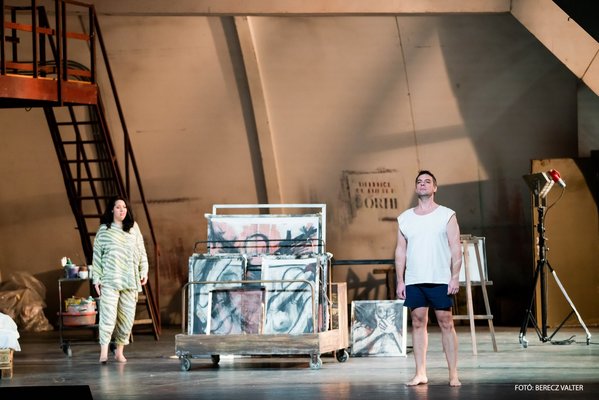
Bartók Béla’s two highly influential stage works explore the dynamics of the relationship between man and woman and the deeper layers of their personalities, as presented by creators who, through a fusion of tradition and innovation, reveal the possibilities inherent in these works for 21st-century audiences. In Venekei Marianna’s choreography of The Miraculous Mandarin, premiered in 2024, the inner world of the characters is examined through the language of dance, set within an evoked big-city milieu. In the production of Bluebeard’s Castle staged in 2018, marking the 100th anniversary of its world premiere, director Kasper Holten reveals the symbolic doors of the male psyche by evoking the former painters' studio of the Opera House.
Parental guidance
Due to sexual themes, this performance is not recommended for children younger than 14.
Events
Premiere: Feb. 3, 2024
The miracuolus Mandarin
Today we mostly find disturbing The Miraculous Mandarin, which is based on Menyhért Lengyel’s pantomime play full of erotica, sexuality and abuse. But at the time of its original premiere in Cologne, it was truly scandalous. Whether disturbing or scandalous, it is certainly an influential work, which travelled the world accordingly. It was played in numerous countries of Europe, America and Asia, and even in South Africa. Marianna Venekei's 2024 choreography explores the inner worlds of the characters and discovers the increasing depths of their personalities, combines past and present to find a way to reach a 21st-century audience while staying true to the music of Béla Bartók.
Bluebeard's Castle
Béla Bartók’s one-act opera, Bluebeard’s Castle is an extraordinary and enigmatic work that, in terms of how it is interpreted and staged, poses an exciting challenge for directors, their creative teams and performers alike. Little wonder that it is such a popular work on opera schedules both in Hungary and abroad. This season, the OPERA returns to the production by internationally acclaimed Danish director Kasper Holten, who has worked on the stages of the Deutsche Oper Berlin, the Theater an der Wien, the Finnish National Opera, the Wiener Staatsoper, the Teatro alla Scala in Milan and the Bregenz Festival, among others. He also served as artistic director of London’s Royal Opera House until 2017. Moreover, it was in Budapest where he shot his 2010 opera film of Don Giovanni, titled Juan. His productions are characterised by simplified, and often monumental, sets and a harmonic balance between tradition and innovative ideas. “To read, listen think and feel. The important thing is to avoid analysing it according to any preconception or always employing the same artistic style, but rather to develop a relationship with the work so I can completely understand what it is about it that fascinates me so much. Only then can I get started on the aesthetics, the concept and so forth,” says Holten.
Media
Reviews
“Marianna Venekei places the violent action of The Miraculous Mandarin in the hustle and bustle of a big city. (…) [The girl] is the puppet of three thugs, from whom she is constantly trying to escape. When she encounters the Mandarin, something inexplicable happens to her; she is unable to break free from his attraction, and these scenes are particularly intense, because a kind of invisible bond chains her to the stranger, who moves her almost like a puppet.”
Ira Werbowsky, Der neue Merker
“With Venekei, we believe in the contemporaneity of these characters. A scrim with a city skyscraper motif opened and closed the action while the graduated physical set recalled a bleak urban rooftop. Its recognizably roughshod denizens wouldn’t look out of place on any present-day city streetscape.”
Gianmarco Segato. Bachtrack
„Very quickly this version began to feel fascinatingly true to the meaning of the work. After all, the castle itself is only a symbol laid on top of the very human feelings explored in the piece, and Holten puts it back into the characters’ imaginations, making the doors all in Bluebeard’s and/or Judith’s heads as his production charts their process of self-analysis.”
John Allison, Opera (UK)
Opera guide
The Miraculous Mandarin
A contemporary story valid since ancient times – The choreographer’s thoughts
This role is a huge challenge for a dancer, it is not conventional and certainly not an easy one to perform. I had such fantastic predecessors as Gabriella Lakatos, Vera Szumrák, or Katalin Hágai, to name a few. For some reason, the choreographer thought I could handle this burden. Not only mentally, but physically – we had to dance around seventy chairs made of iron, and I even had to overturn some of them. It was such a physical strain that I remember staggering off the stage after the performances. These memories stayed with me, I had time to reassess them, and they obviously appear in the current female character. But that version had a different concept than mine. The curtain closed behind her, she stood alone on the stage, and in these moments, I enjoyed thinking about what she experienced, what happened to her, what this meeting meant for her.
In the case of Bartók’s ballet, telling a story is not complicated, since it is a programmatical music, there is a libretto written by Lengyel Menyhért, and the music set to it. Every moment is taken down precisely. A Streetcar Named Desire was similar in this way, the story is tangible, almost word for word.
The power of The Miraculous Mandarin’s message cannot fade until human nature is radically changed. In this sense, this story is contemporary – and yet valid since ancient times. That is how it was written, but it could and does happen today. If we look at reality, the human world, perhaps there is no liberation; pain and torture, violence, and abuse are as old as humanity, cruelty and coercion have always been present, and I think they will go on being present.
In my concept, the mandarin is more an apparition than a phenomenon. The girl used as a prostitute experiences a genuine relationship, a connection with the mandarin, who will be her saviour, who will bring her redemption. The language of movement and visuals are built around the action, the story moves the performance forward, which is also necessary because some people may not be used to modern choreographers without a plot. There is a powerful story with a characteristic atmosphere: a run-down house and modern costumes. It was very important to me that everything from the first button to the last nail exudes this special atmosphere.
Marianna Venekei
The Miraculous Mandarin at the Hungarian State Opera
The history of the creation of The Miraculous Mandarin, the last of the pieces of Bartók’s dramatic triptych to be staged at the Opera House, resembled that of The Wooden Prince in that it began under the auspices of the journal Nyugat. Menyhért Lengyel’s “pantomime tale” was published in the periodical’s 1 January 1917 issue. The author was already very well-known: many of his dozens of plays (especially 1909’s Typhoon) were highly successful. Upon reading the text, Bartók wrote a letter to Lengyel, requesting his permission for him to set it to music: after receiving an affirmative reply, he set to work in the autumn of 1918. “It will be diabolical music, if I succeed,” he wrote to his wife. Although the writer was a sincere admirer of Bartók’s (once referring to him as an “absolute genius” in his diary), he had supposedly originally intended for the pantomime to be used by Diaghilev’s Ballets Russes.
In any case, by May 1919, Bartók had completed a draft composition, but he put it aside for the duration of the ensuing stormy historical period that profoundly affected both him and his work. In December 1923, however, he wrote that it was now “high time to score the Mandarin.” He put his resolution into effect the following year: by November 1924 he had finished the orchestration, and the Universal publishing house released the piano reduction of the work in 1925. In February of that same year, Bartók began talks with the management of the Hungarian Royal Opera about performing it, but no agreement was reached.
Eventually, the world premiere of The Miraculous Mandarin would be held in Cologne (Bartók’s and the publisher had both chosen Otto Klemperer, who was planning to take over the post of chief music director there, to conduct it. Although the post would eventually go to Jenő Szenkár, Cologne remained as the venue.) The premiere credited to Szenkár and Hans Strohbach (in which the work was performed together with Bluebeard’s Castle) caused a scandal. Mayor Konrad Adenauer, who later became Chancellor of Germany, personally banned the production, calling it an “offshoot of a rotten culture”.
The pantomime enjoyed a favourable reception in Prague a year later, but by 1931, Bartók had revised the ending. Negotiations with the Opera resumed that same year: the premiere was duly scheduled for 25 March 1931 (Bartók’s 50th birthday) with a choreography by Rezső Brada and László Márkus directing. But then, with the alleged illness of the female lead, Karola Szalay, cited as the reason, it was abruptly cancelled. On leaving the rehearsal, Bartók commented: “You’ve all been misled, you don’t even know my music.” The Miraculous Mandarin was very nearly performed again ten years later (this time in a version by Gyula Harangozó, who had already proven his talent to Bartók and the audience with his choreography of The Wooden Prince), but the premiere was axed yet again. The reason given was again “illness”, but it was actually pressure from above “for moral reasons” that led to the cancellation. As Gábor Devecseri wrote in Nyugat: “This flu has now become a tradition.”
After working on it for many years, Aurél Milloss staged Mandarin at Milan’s La Scala in 1942, making him the first Hungarian choreographer to mount the work. He later taught it to many other companies. Only in 1945 would Harangozó be allowed to stage the work at the OPERA, not long after the composer’s death. The version that was performed was tragicomic in how far removed it was from Bartók and Lengyel’s original story. Instead of a bustling city, the events took place in a fabricated “Asian” setting, and the characters were changed to the point of unrecognisability. Bartók’s work finally found its way to the stage of the Opera house in an authentic form in Harangozó’s emblematic 1956 second version, which was performed – as interpreted by a host of the company’s greats in alternating casts – was all over the world from Edinburgh and Cairo to Moscow. At the premiere, the principal roles were danced by the immortal trio of Gabriella Lakatos, Ernő Vashegyi and Gyula Harangozó. (Hungary’s first authentic version of Mandarin was staged in Szeged in 1949 by György Lőrinc.)
“Figures realistic and unrealistic, symbolic and naturalistic, move up and down the stage simultaneously, conveying multiple meanings in a single person,” explained László Seregi at the premiere of his first production of Mandarin. The choreographer first staged the work in 1970, and he then went on to come out with new versions in 1981 and 1989. Choreographer Antal Fodor staged Bartók’s work at the OPERA twice: first in 1985, and then in 1993. A choreography of The Miraculous Mandarin created by Jenő Lőcsei was performed at the OPERA in 2006.
Tamás Halász
Bluebeard's Castle
Introduction
“This piece by Béla Bartók is the greatest thing that has happened here, in this city, in my lifetime. […] it was a revelation to me, like a new continent, some kind of proclamation,” wrote Sándor Bródy. Who is Bluebeard? Perhaps the accursed Conomor, who murdered his pregnant wives, or Gilles de Rais, the 15th-century French nobleman? Or maybe Perrault’s famous fairy-tale figure, or Anatole France’s perennial fool corrupted by women, whose image posterity magnified? According to László Bóka, he is “the embodiment of an adolescent liberated into love and his world of desires,” a tragic Don Juan who is given the chance to open himself through self-examination, but “memory, like a dreadful waxworks, preserves its victims in petrified form,” and thus it is inevitable that the new wife also becomes part of this panopticon.
In 1918 Izor Béldi wrote disapprovingly in Pesti Hírlap about the work’s psycho-sexual embeddedness, the aggression of selfish sexuality, yet paradoxically he could not resist the power of the music: “Bartók’s music even outbids Balázs’s pathological text: a kind of musicalised psychopathia sexualis […] but even in this aberration an extraordinary creative force destined for the greatest tasks manifests itself.” Kodály, writing in Nyugat, highlighted the musicality of the naturally stressed, Hungarian-style declamatory language use, but he also emphasised the intentional dismantling of operatic clichés. This is perhaps the real scandal of the piece: Bartók’s apparent alienness to tradition is, from a Hungarian perspective, the greatest linguistic-musical sense of home.
Zoltán Csehy
An “unperformable” opera
“I would go to the rehearsals of Bluebeard; I would go to the performance of Bluebeard! Now I know that I will never hear it in my life.” Sometime at the beginning of 1915, this cry of pain burst from Béla Bartók in a letter to his wife, recalling the already years-long, hopeless ordeal of his opera. Duke Bluebeard’s Castle was completed between March and September 1911, and that October Bartók entered the opera, setting Béla Balázs’s mystery play to music, into the Lipótváros Casino’s Ferenc Erkel Prize competition. Unperformable – so went the judges’ verdict, and a few months later the Rózsavölgyi Music Publishing Company’s opera competition, and subsequently the Hungarian Royal Opera House, evaluated Bluebeard in much the same way. “I have been officially executed as a composer,” Bartók complained afterwards to one of his younger colleagues, Géza Vilmos Zágon (incidentally the cousin of Béla Zerkovitz), for “either they are right, in that case I am a talentless bungler; or I am right, in which case they are idiots.”
The injury done to the genius was then remedied within just a few years, and not even a revolution was needed: it was enough – quoting Béla Balázs – to apply “the aristocratic superiority, the aristocratic cool-blooded impudence.” Miklós Bánffy, who created a brief golden age at the Opera House, used his authority as intendant to push through the premiere of Bluebeard’s Castle, and since May 1918 the appreciation of Bartók’s only opera has depended not only on the musical and operatic institutions but also on us, the opera-going public. And however difficult it is to admit, we sometimes contemplate Bluebeard with a certain embarrassment. The cause of this discomfort mostly lies in Béla Balázs’s work, for right from the Bard’s spoken prologue it uses irritatingly contrived, contriving turns of phrase: “The castle is ancient, and this story / About it is ancient too. / Now you too shall hear it.”
Balázs Béla and Those Who Do Not Need Him – György Lukács published a militantly pro-Balázs collection of essays under this very title in 1918, yet in truth the Hungarian reading public has kept a certain distance ever since from the otherwise much-merited and widely active writer’s style. But Bluebeard is made disquieting not only by its wording but also by its plot and message, and this can hardly be separated from Bartók’s contribution and his artistic stance. For the heroic-tragic portrayal of the incurably lonely male soul seems partly affected, partly utterly lacking in self-reflection. So, with some shame we may even feel that those doors all open to the same place in truth. And yet we continue to marvel at this conspicuously un-operatic and so difficult-to-stage wonder. Behold, this is our realm!
Ferenc László
A French legend on the Hungarian opera stage
The myth of Bluebeard is traditionally linked to two historical figures. One is the 1st-century ruler of Brittany, Conomor the Cursed, who killed his wives when they became pregnant. According to the legend, the ghosts of his previous wives warned his last spouse, allowing her to escape. The other historical figure was a 15th-century nobleman named Gilles de Rais. Despite being an educated man who had participated in the Crusades, the “pious monster” eventually turned to occultism and committed terrible murders. Accounts say that his beard had a tint of blue when seen in a certain light. The story of Bluebeard became well-known when Charles Perrault’s published his collection of tales in 1697. The subject was rediscovered in the Romantic era and was adapted by several authors. With his short story Les Sept Femmes de la Barbe-Bleue, Anatole France was the first to depict Bluebeard not as a murderous beast, but rather as a clumsy man who is dominated by women.
The story has appeared in Hungarian folklore as well – for example, in the Ballad of Anna Molnár and the story The Wife of the Mason Kelemen. The young Hungarian writer Béla Balázs was inspired by the legend too, especially Maurice Maeterlinck’s version, the symbolic play Ariane et Barbe-Bleue ou la délivrance inutile (Ariane and Bluebeard or The Useless Rescue), which served as the basis for the 1907 opera by Paul Dukas. Béla Balázs wrote his own version for the stage with the title Duke Bluebeard’s Castle, the full text of which was published in the periodical Stage Drama on 13 May 1910. Music historian György Kroó argued that Béla Balázs “originally offered the mystery play to Kodály, and he read his play aloud to him in 1910. Bartók, who was also present to hear it, was captivated by the theme.”
Judit Kenesey
The strange world of a co-dependant relationship – The director’s concept
This invitation was a real gift to me as I’ve always felt that the early 20th-century repertoire is very close to me, so I was really looking forward to rehearsing this incredible piece. I have, of course, seen many productions done of it over the years. I’ve tried to take a slightly different approach from the directions I’ve seen before. In this version, I don’t want to present Bluebeard and Judith as a couple at the beginning of their relationship, but rather as a man and a woman who have been living together in a marriage for more than twenty years.
Bluebeard is a successful and wealthy painter who started his career as a talented but poor artist. At the beginning of their relationship, Judith gave up the safety of her family and fiancé for this poor artist. Bluebeard has since become a world-famous painter, and despite the pain that creative work causes him, it is only to his art that he can fully open up and be himself. This is what Judith is jealous of, and she began to row and fight with her husband, as she wants him to fully open his soul to her. The story is circular: these arguments are repeated every few years, just like with other couples who have been living together for decades; what’s more, sometimes even some humour appears in their disputes, as often happens in real life. It’s just one room, and there’s no-one else on the stage but a man and woman trapped in this room and in this relationship, in which they are both unhappy, although they can’t live without each other, either. I’d like to focus on these two people; that’s why I decided to leave out the prologue at the beginning of the production.
Bluebeard’s castle is his soul, so we wanted to create a space that reveals a lot about this man. This is how the set of the production is one of Bluebeard’s homes (he probably has a lot of homes, anywhere from New York to Paris and London), which is a studio apartment where he still leads quite a Bohemian life. The set was inspired by the Hungarian State Opera: we visited the painting workshop of the Opera House before the reconstruction works began, and we were impressed by its spaciousness and atmosphere. The seven doors appear in the production too, although symbolically. Bluebeard has seven scars on his body that, for Judith, represent Bluebeard’s secrets, doors to his soul. But it is a central point of the production that the doors do not have a physical manifestation on stage – they are metaphorical and represent the narrative about aspects of Bluebeard’s soul that Judith wants him up to open to her, to share with him. And, as such, the absence of physical doors are in a way a point: Judith thinks he has these specific secrets inside him that she needs to know, when in fact of course the identity of Bluebeard (or anyone else) is not a fixed narrative, but much more something that is constructed and flexible.
What is hidden behind them is the entire psychological world of Bluebeard, the artist. The first door is the torture chamber, that is Bluebeard’s work: creating art has become torture for him. Behind the second door are the weapons, that is a lot of empty liquor bottles - this is how he fights, how he works. The third door’s treasures are his paintings, which are that worth lots of money, but are also covered with blood - they have cost him a lot of pain in their relationship. The fourth door is the flower garden which is the floral dress Judith was wearing the first time they made love. At the fifth door a massive change happens, as Bluebeard decides not just to reveal things, but to change his destiny: he decides to destroy his paintings and to give up his work he wants to be free and sees before him eternal freedom, the open realms of his future.
Although Judith is the one who keeps pushing Bluebeard to open up for her, she also needs him to remain this mysterious artist whom she cannot understand. Without this, she would lose her identity. Therefore, she cannot stop questioning him. The sixth door reveals the lake of tears: Judith holds up a mirror to him, and the flood of tears are Bluebeard’s own. He is opening up. He wants to stop there, but Judith starts to talk about Bluebeard’s previous women. The seventh door opens, and he turns the mirror towards Judith, suggesting her eternal jealousy has been in vain: she is all the women he has ever loved. The morning bride when she wore the floral dress, the midday bride when they had a child, the evening bride when they got older together, and now she becomes his midnight bride, cold and hard.
We are left at the end with the question about whether this cycle of mutual dependency and abuse will stop here, or repeat itself. I hope this concept shows Bartók’s own struggles as an artist and as an individual. The music clearly reveals the fact that it’s an extremely personal story, and we wanted to move the piece from the gothic to the personal, making it at once more symbolic and yet very direct. I hope we can bring out this artistic personality and create a production that is somewhat different from previous ones.
Kasper Holten