
The Spinning Room
Details
In Brief
Parental guidance
Events
Premiere: Nov. 29, 2025
Synopsis
The Lady of the house's husband is dying; the woman and her young daughter are soon left bereft. With an aching heart, the mourning widow remembers her younger days, when she was getting to know her future husband. In order to cheer up her saddened daughter, she sings Cockrikoo! to her. While they are getting ready for the funeral, the Lady of the house reminisces further and further back into the past, recalling how she and her suitor were married. The lovely memory of the wedding, however, is suddenly overshadowed by the ominous appearance of the Flea. The Lady of the house continues with her recollections, recalling the birth of their daughter. After the funeral, she erupts in grief into the Ballad of the Bad Wife. Suddenly, she seems to see her dead husband in front of her again, but then is forced to realize that it was only an illusion. Feeling bitter, she goes to bed and – refusing to accept either comfort or food from her daughter – she is gradually consumed by sorrow. Her daughter mourns her in silence. The Lady of the house and her husband are reunited in heaven.
Media
Reviews
"Znaniecki can be one of those directors who bring an over-packed suitcase of ideas, yet here his imagination never overpowered the work. Making the parting something even more tragic – and surreal when the man returned as a vision –he underlined both the profundity and innocence of the piece."
John Allison, Opera
“It was no easy task for Michał Znaniecki when he was invited to stage The Spinning Room and became the first to be given the opportunity to reinterpret this distinctly Hungarian work on the international stage. (…) He successfully found the common denominator of European folk traditions; particularly striking in its power are the washing, laying out, and lamentation of the dead, as well as the appearance of the Flea’s village masqueraders with the coffin. Likewise, costume designer Magdalena Dąbrowska created a visual world into which the son of any nation can project his own rural memories – or, if nothing else, at least the life of his grandparents.”
Eszter Veronika Kiss, Magyar Nemzet
„The Budapest première of his new production design triumphs over many obstacles, which includes a long-entrenched attachment to a more sentimental approach since 1932, by refashioning such a sequence with enlightened cleverness and dramatic intelligence. (…) The Polish team and Scoglio and his assistant Alejandro Cortés achieved a minor miracle with this ‘opera,’ turning it into a radiant vehicle that creates cohesion and visual delight while still respecting its traditional roots.”
Alexandra Ivanoff, Bachtrack
Opera guide
Introduction
“This drama is the life of the people and of the entire Hungarian nation. The great task, therefore, was this: to set the scenes of the drama on the stage in such a way that they would speak for themselves, in their own words, telling the untold – and perhaps in its full entirety forever untellable – great whole: the Hungarian Drama. The plan, the idea, the undertaking, in the unparalleled boldness of its conception, truly stands alone – and in its complete boldness it succeeded.”
Hardly had a human eye yet seen, hardly had a civilian ear yet heard The Spinning Room when, on the morning of the 1932 premiere (!), writings like this, and similar others had already consecrated Kodály Zoltán’s new work in advance as a national classic, indeed as something even more. Bence Szabolcsi, the author of the quoted “review,” together with Aladár Tóth and many other devoted supporters and champions of Kodály, thus effectively decided for the entire twentieth century what we were to think of The Spinning Room.
Yet alongside its beauties, values, and indisputable merits, the vulnerable points of the work were likewise evident from the very beginning. Chief among these is the fact that although Kodály brought a series of Székely-Bukovinian and two Nyitra folk songs onto the operatic stage, he did not – indeed perhaps did not even wish to – create a musical stage drama in the commonly accepted sense with the capitalized “Hungarian Drama.” The plot – or rather, merely a sketch of a plot – on the one hand scarcely connects with the order of the songs, and on the other hand functions on stage more as ballast than as a source of dramaturgical momentum. Thus even the early admirers honestly stated that The Spinning Room “is not an opera, only a masterpiece,” and later analysts, from time to time, likewise noted the statically oratorio-like quality of this masterpiece, its near alienness to the stage. And what else could people of the theatre do but, for ninety years now, search and probe for some kind of valid solution to the “wooden iron” problem that, in Hungarian opera history, is by no means unique.
For The Spinning Room is something we cannot let go of or allow to be lost. The first-person plural here truly has a collective meaning: it refers to us, Hungarians. For we may feel this work to be our most personal common cause not only when, in the performance of the Girl and the Young Man, “Under the Mountains of Csitár” is heard, but already at the very first song, “I Will Go, I Will Go” – and then throughout. Even if we have seen village life only in passing, and a spinning room not at all. These songs still strike us to the quick today, beyond the museumification and open-air-museum status of folk culture, and beyond its dance-house renaissance. And when we marvel at Kodály’s setting of these “beautiful, polished, pure, warm-hearted, precious stones,” it is difficult not to perceive, without a sense of awe, the composer’s masterly skill.
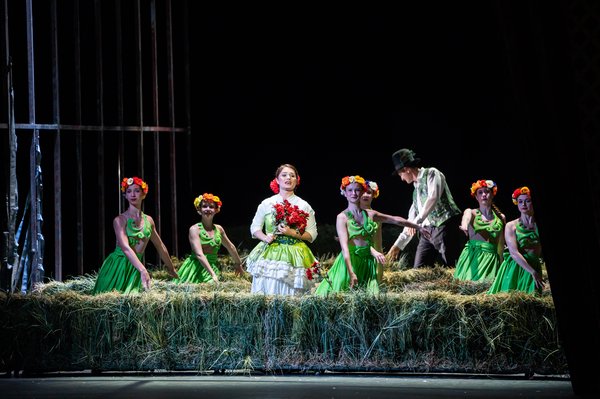
With the OPERA’s 2016 production, the Pole Michał Znaniecki and his creative team approached The Spinning Room boldly and from the position of an external – though by no means cold – gaze. That is, they constructed a new plot, and the resulting vision-like recollection, wound back from female mourning, in a sense encompasses the entire work. This solution is, of course, debatable, but on the whole workable, and in fact not so far removed from the shared retrospection with which Hungarian opera audiences can look back upon folk culture.
Ferenc László
Stories about ourselves – The director’s concept
It is difficult to identify a genre for The Spinning Room: it is neither an opera, nor simply is it a collection of folk songs, because Kodály elaborated it like classical music and selected the songs according to their dramaturgical requirements. I was surprised that the composer had tried to construct a story from the folk songs, building a context for something that should not have a context. Folk songs and folk tales – similarly to fairy tales – work only when they are not linked to an actual era, culture, or place that we should know. These songs and ballads speak about ourselves and our emotions: our fears and happiness, love, and death. The stories of folk tradition touch those ancestral roots that are hidden inside all of us – not only inside Hungarians and Transylvanian Hungarians. When you hear other nations’ folk songs – whether they might be Polish, Italian or Brazilian – you realise that they are all very similar in terms of their themes and effects, although not in their melodies. Folk music is a kind of ritual: it moves something in our souls that makes us homesick, links us to our country and recalls our childhood. But how can we manage to generate the same emotions in the audience as those who grew up with these Szekler songs and melodies feel? Roughly half of the audience of the OPERA is composed of international visitors – like myself. So I felt that my task was to help these visitors get a sense of what these Hungarian songs really meant.
I tried to respect the tradition of the piece, in terms of both its folk roots and how it has traditionally been performed. Having said that, I also tried to look at it from a more distant perspective, with a kind of “innocence”. Although Kodály provided dramatic instructions for the songs, there is no particular story developing from the games in the spinning room. Aside from preserving traditions and popularising Hungarian folk music, the author must have had some reason for the dramatic structure, since he intended this work for stage. But what is the piece about? The characters do not have names; it is a kind of a Jedermann piece. So I thought we should simply speak about “anyone”, which means everyone, irrespective of their place in time or nationality, and we should not be afraid of using simple and almost basic tools – ones that Kodály himself worked with. I focused on those central motifs and moments that are common in all of our lives: love, hate, fear, death, birth and family – I tried to connect these general topics and surround them with universal and easily understandable symbols. What I want is for the viewers to be impacted by the force of the folk songs themselves. I do not want their attention to be diverted by a perception of excessive activity or spectacle on the stage.
Michał Znaniecki
Folk dancing on the stage – The choreographer’s thoughts
I happily accepted the invitation, partly because it is a great honour to work for the OPERA, and partly because stage director Michał Znaniecki’s requests regarding the choreography of The Spinning Room are very close to my own thinking about theatre and the art of dance. He asked me to merge folk dance with elements slightly detached from it, so in this production I combined authentic dance motifs with invented movements in a way that the character of the whole of the choreography evokes a folk style. There are typical Székely dance motifs, such as whirling duets in the finale. The invented dance elements are rooted in folk dance too; I did not want to include contemporary or modern dance forms in the choreography. This production of The Spinning Room features a more open and comprehensive interpretation of folk dance. I especially like the fact that Michał does not present authentic genre scenes: his aim is not to present or illustrate the original Székely environment but show the character’s internal emotional world. He tries to tell a story of a fate, elevated to a universal level, using a contemporary theatrical language and unique forms. In my production, I myself strive to find a channel through which I can address today’s audiences from the past, based on the “vernacular” of folk dance and using modern forms.
Since the marvellous dances of peasant culture first appeared on stage, there has been an ongoing debate about the way it should be presented: those on the side of authenticity argue that dances must be danced on the stage exactly as village people used to do, while other artists with a theatrical approach and more liberal views claim that authentic folk dances must be developed further on the stage. The concept of ‘folk art’ is a subject to debate too: can folk dance be regarded as art at all? On the one hand, it cannot, because originally it used to be a means of entertainment, and, on the other hand, it can, because peasants, after all, did develop this wonderful world of forms, and thus a work of art had come into being. I agree with the latter: it is folk art, in which, moreover, centuries of pan-European cultural treasures have accumulated. If we present it on the stage simply as an illustration, then the message of the community might not reach the audience; we must dig deeper and approach the audience in a more abstract way and use new forms. Kodály and Bartók initiated this idea: showing peasant culture in a modern theatrical environment. And it was also their creed that we must find the roots, dive into the clear water of this spring and then create something new from it. This is what I profess as a choreographer.
Zsolt Juhász