
Timeless Contemporary Adventure
Petite Mort, Six Dances
Details
In Brief
The Timeless Contemporary Adventure 2 promises a ballet performance designed especially for younger audiences. The ballet show is composed of works by choreographer Jiří Kylián from the Czechia, where the dancers’ technical virtuosity intertwines with the music of Mozart. Contemporary yet classical, chamber-like yet varied and breathtaking – such is the programme awaiting those who come to see the three productions: Petite Mort and Six Dances. The pieces are typically plotless, yet many aspects of life appear within them, such as the dynamics of human relationships – sometimes in a more serious, sometimes in a more humorous form.
Parental guidance
Events
Premiere: Aug. 23, 1991
Petite Mort
Jiří Kylián has always admired Mozart; over the course of his career, he has created a number of choreographed to the composer's music, including one from 1991 that paid homage to the genius of the 200th anniversary of his death.
Featured in this uniquely atmospheric ballet are six women, six men and six swords. In addition to the weapons, other props include black, baroque-style clothing and bizarre crinolines. The symbolic image in the dance piece presents a world where aggression, sexuality, silence, music, vulnerability, interdependence and eternal human beauty exist together in their own sense of poetry. This ballet from the choreographer's mature period is characterised by daring visuals, superb dance performances, elegance and style and has featured in the Hungarian National Ballet's repertoire since May 2013.
Six Dances
"I've decided that I cannot simply create a dance series reflecting the composer's sense of humour and music genious. Instead, I've choreographed six visibly confusing scenes..." (Jiří Kylián)
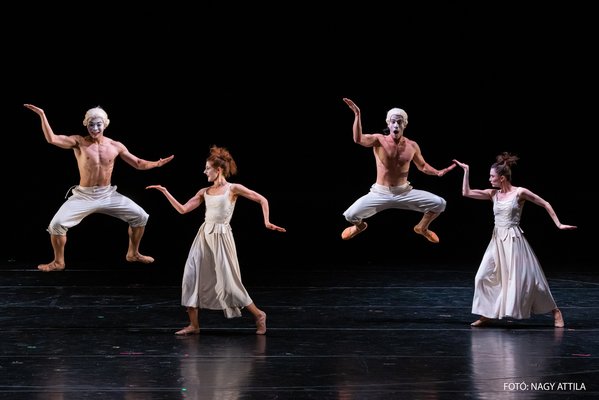
In Kylián's ballet, Mozartian playfulness and absurd reality are transplanted into the language of movement. It was not a story that he set out to create, but rather a dance piece constructed out of the absurd situations encountered by heroes in powdered wigs who sometimes act irrationally and awkwardly: the very dictionary definition of the word "burlesque". From the first moment, the eight dancers take the stage like they are stepping out of a wax museum from Mozart's own era, and then the innovative freshness and dizzying dynamic of the choreography makes them ever more modern: timeless heroes of Kylián's absurd creative world.
Media
Ballet guide
Petite Mort
Jiří Kylián created the ballet Petite Mort specifically for the 1991 Salzburg Music Festival, to mark the second centenary of Mozart’s death. Six women and six men dance to excerpts chosen from the composer’s perhaps most beautiful piano concertos (No. 21 & 23) in this extraordinary dance piece. Six fencing foils, which move together with the dancers almost as their partners, also feature in the work, often creating more surprising, more unruly, more distinctive situations than dancing with partners made of flesh and blood. While the foils are symbols of a thousand things for men, masculinity being just one of them, the choreographer stresses femininity with black baroque dresses and bizarre crinolines. These props come to life, moving and rolling, at times forming the women’s bodies and at others drifting apart from them to live a separate existence.
Foils, dresses, torsi, women, men, heads, bodies, and limbs... These elements are not the accessories of some form of provocation; Kylián’s visual symbolism presents a world where aggression, sexuality, silence, music, vulnerability, interdependence and eternal human beauty exist side by side in a particular poetic medium. Majestic and timeless dialogues of frivolous sensuality and heightened emotions take place in the duets and group dances that happen before the spectator’s eyes. “Petite Mort”, literally meaning “little death” in French, refers to sexual fulfilment, the wondrous, passionate moment of ecstasy when reality is briefly lost. The phrase is also used when something tragic happens which affects a person to such an extent that “a part of them dies”. Kylián, following his many impressions of death, expands his ballet woven with symbolic images into a kind of danse macabre. The thought that accompanies people through their entire life, even in its most inspired moments, interweaves the series of gorgeous duets with sometimes unusual solutions that at the same time emanate virtuosic elegance. A bold spectacle, tremendous physical dancing performances, elegance and a sense of style are the hallmarks of this ballet from the choreographer’s mature period.
Rita Major
Six Dances
Six Dances is presented as a pendant to Petite Mort. In Jiří Kylián’s own words: “Mozart, whose music I have chosen for this production, is the greatest example of someone whose lifespan was painfully limited but who nevertheless understood life in all its richness, clownery, and madness... he understood that life is no more than a masquerade, a dress rehearsal for something much deeper and more meaningful... Although the entertaining quality of Mozart’s Six Dances enjoys great popularity, it shouldn’t only be regarded as a burlesque. Its humour ought to serve to point towards our relative values... I decided not to create dance numbers simply reflecting the composer’s humour and musical brilliance. Instead, I have set six seemingly nonsensical acts…”
In the ballet, which premiered in Amsterdam in 1986, Kylián transposed Mozartian playfulness and the absurd reality into the language of dance. He did not wish to relate a storyline, but rather, using the dictionary definition of burlesque, he built a dance number on the nonsensical and comic situations of awkward heroes often behaving unrealistically. Frivolity is not lacking from this piece either; the vivacious scenes are brilliant caricatures of the multifaceted yet familiar relationships of men and women. Besides the scintillating choreography connecting the technique of classical ballet with individual movements specific to the choreographer in memorable combinations reminiscent of social dances, important supporting roles are given to the props: the tussled coiffures, the masked faces, the clouds of powder ascending from the periwigs, the tight breeches, and the flouncy, twirling women’s dresses. In the very first instant, the eight dancers appear on stage like waxworks figures from the age of Mozart. Then the inventiveness, originality and dizzying dynamics of the choreography turn them into increasingly modern, timeless, universal heroes of Kylián’s absurd creative world. And all the while the brilliance of Mozart does not disappear for a moment, ever present in his music, in the ambience, in the visual extravaganza.
Rita Major